Black-Gloss Mesomphalic Phiale (Libation Bowl): Apotheosis of Herakles (200s BCE): Art, History and Details
Black-Gloss Mesomphalic Phiale (Libation Bowl): Apotheosis of Herakles at the Cleveland Museum of Art: 200s BCE, ceramic. Explore the work's context, creator attribution and collection history.
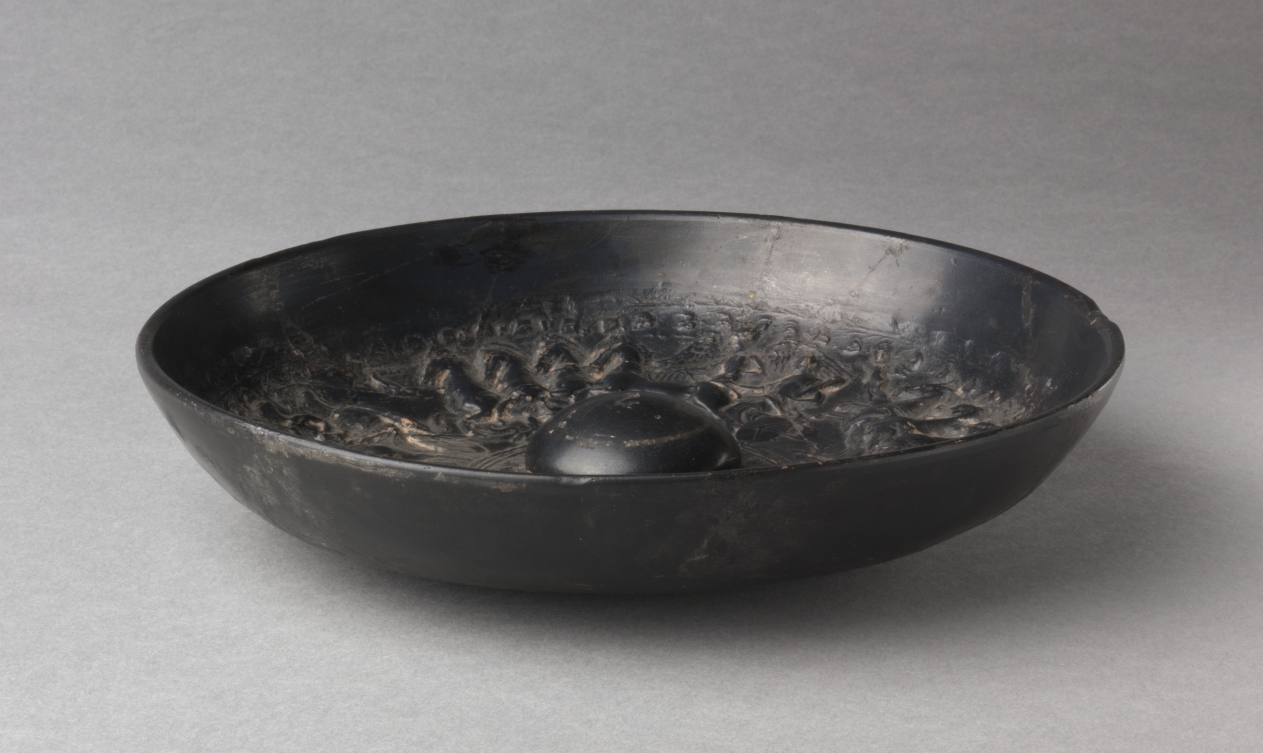
Black-Gloss Mesomphalic Phiale (Libation Bowl): Apotheosis of Herakles (200s BCE) is in the Cleveland Museum of Art collection.
The work and its context
The museum's open-access catalogue describes the work:
Four four-horse chariots proceed around the interior of this libation bowl, each driven by a winged Nike (Victory) and accompanied by a flying Eros. Each carries a different figure—Athena, Herakles, Ares, and Dionysos—and small animals race along before the horses. The appearance of Herakles with these Olympians suggests his apotheosis.
Object facts
- Title: Black-Gloss Mesomphalic Phiale (Libation Bowl): Apotheosis of Herakles
- Date: 200s BCE
- Culture: South Italian, Campanian (Calenian)
- Type: Ceramic
- Technique: ceramic
- Dimensions: Diameter: 20.6 cm (8 1/8 in.); Overall: 4.4 cm (1 3/4 in.)
- Collection: GR - Greek
- Department: Greek and Roman Art
- Accession number: 1926.515
A detail from the museum
This type of glossy ceramic vessel likely imitates costlier objects made of precious metal.
Collection credit
Purchase from the J. H. Wade Fund
Further reading listed by the museum
- Beazley Archive. n.d. Beazley Archive Pottery Database. Oxford: Beazley Archive.
- Boulter, C. G., Jenifer Neils, and Gisela Walberg. Corpus Vasorum Antiquorum. Princeton, N.J.: Princeton University Press, 1971.
View the collection record
See the museum's photographs and full catalogue entry. Catalogue text is reproduced from the Cleveland Museum of Art's open-access data, with HTML formatting removed. This object and its supplied image are designated CC0.
Sources
More in Lifestyle
Keep reading