Bodhidharma (early to mid-1500s): Art, History and Details
Bodhidharma at the Cleveland Museum of Art: early to mid-1500s, hanging scroll; ink on paper. Explore the work's context, creator attribution and collection history.
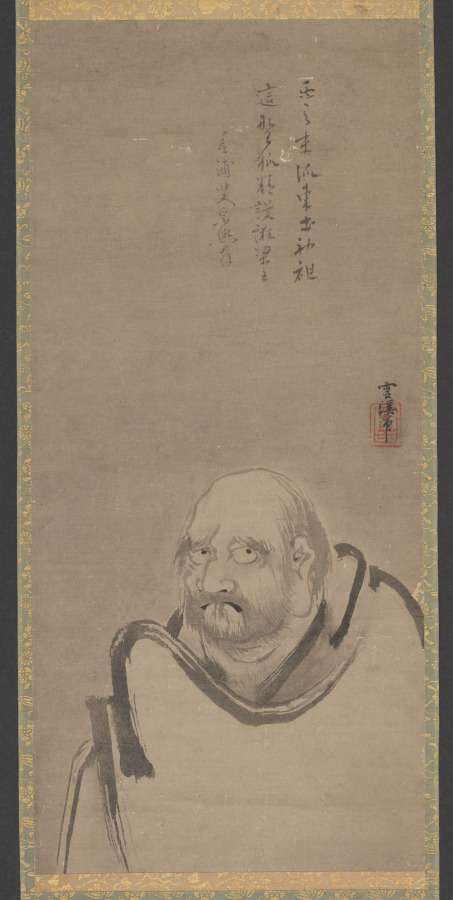
Bodhidharma (early to mid-1500s) is in the Cleveland Museum of Art collection. The museum's creator attribution is Unkei Eii (Japanese, active c. 1504–1555).
The work and its context
The museum's open-access catalogue describes the work:
Chan (Japanese: Zen) Buddhism was introduced to China in the early 500s by Indian monk Bodhidharma (Japanese: Bodai Daruma; died before 534). It is said that upon his arrival in China, Bodhidharma was permitted to meet with Emperor Wu (reigned 502–49) of the Liang dynasty. Realizing the emperor did not understand his religious goals, the monk left and crossed the Yangzi River on a reed, settling in Henan Province’s Shaolin Monastery. This painting is a portrait of Bodhidharma accompanied by an inscription refering to his encounter with Emperor Wu.
Object facts
- Title: Bodhidharma
- Date: early to mid-1500s
- Creator attribution: Unkei Eii (Japanese, active c. 1504–1555)
- Culture: Japan, Muromachi period (1392–1573)
- Type: Painting
- Technique: hanging scroll; ink on paper
- Dimensions: Painting: 56.6 x 25.9 cm (22 5/16 x 10 3/16 in.); Mounted: 127.5 x 27.7 cm (50 3/16 x 10 7/8 in.)
- Collection: ASIAN - Hanging scroll
- Department: Japanese Art
- Accession number: 2015.472
Collection credit
Gift from the Collection of George Gund III
Further reading listed by the museum
- Cunningham, Michael R., Shinʼichi Miyajima, and Yūji Yamashita. Ink Paintings and Ash-Glazed Ceramics: Medieval Calligraphy, Painting, and Ceramic Art from Japan and Korea. Cleveland, OH: The Cleveland Museum of Art, 2000.
View the collection record
See the museum's photographs and full catalogue entry. Catalogue text is reproduced from the Cleveland Museum of Art's open-access data, with HTML formatting removed. This object and its supplied image are designated CC0.
Sources
More in Lifestyle
Keep reading