Bodhisattva (c. 1200–1250): Art, History and Details
Bodhisattva at the Cleveland Museum of Art: c. 1200–1250, lacquered wood with color, gilt copper, and cut-gold (kirikane). Explore the work's context, creator attribution and collection history.
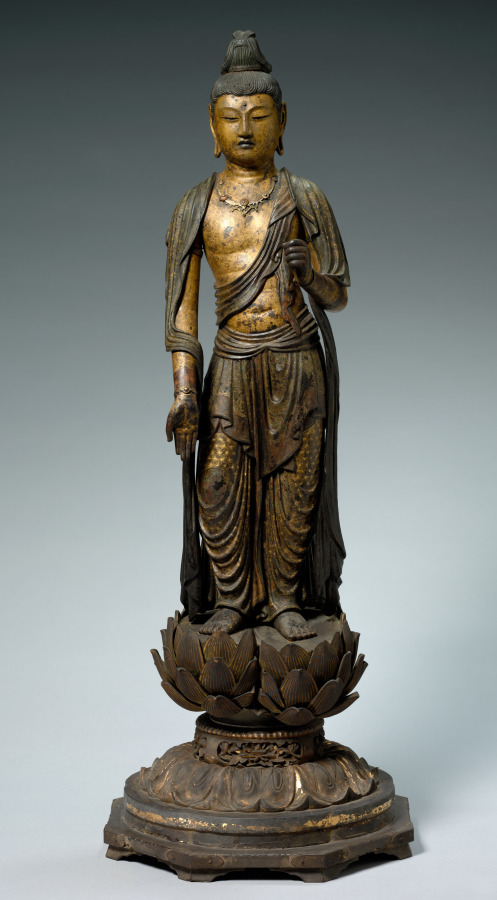
Bodhisattva (c. 1200–1250) is in the Cleveland Museum of Art collection.
The work and its context
The museum's open-access catalogue describes the work:
This sculpture represents one of two bodhisattvas who flank the Buddha Amida, the Buddha of Infinite Life and Light. He has one foot in front of the other and his right leg bent at the knee to show that he is in motion; his torso also sways. He accompanies Amida as he descends to collect a dying person who has asked to be born after death into Amida’s Pure Land, a place conducive to progressing along the path to enlightenment.
Object facts
- Title: Bodhisattva
- Date: c. 1200–1250
- Culture: Japan, Kamakura period (1185–1333)
- Type: Sculpture
- Technique: lacquered wood with color, gilt copper, and cut-gold (kirikane)
- Dimensions: with base: 76.2 cm (30 in.); without base: 55.9 cm (22 in.)
- Collection: Japanese Art
- Department: Japanese Art
- Accession number: 1952.90
Collection credit
John L. Severance Fund
Further reading listed by the museum
- Lee, Sherman. "A Japanese Wood Sculpture of the Kamakura Period." The Bulletin of the Cleveland Museum of Art 42, no. 3 (March 1955): 45–48. Published as Kwannon
- The Cleveland Museum of Art. The Cleveland Museum of Art Handbook. Cleveland, OH: The Cleveland Museum of Art, 1958.
- The Cleveland Museum of Art. Handbook of the Cleveland Museum of Art/1966. Cleveland, OH: The Cleveland Museum of Art, 1966.
View the collection record
See the museum's photographs and full catalogue entry. Catalogue text is reproduced from the Cleveland Museum of Art's open-access data, with HTML formatting removed. This object and its supplied image are designated CC0.
Sources
More in Lifestyle
Keep reading