Bodhisattva (late 100s CE): Art, History and Details
Bodhisattva at the Cleveland Museum of Art: late 100s CE, schist. Explore the work's context, creator attribution and collection history.
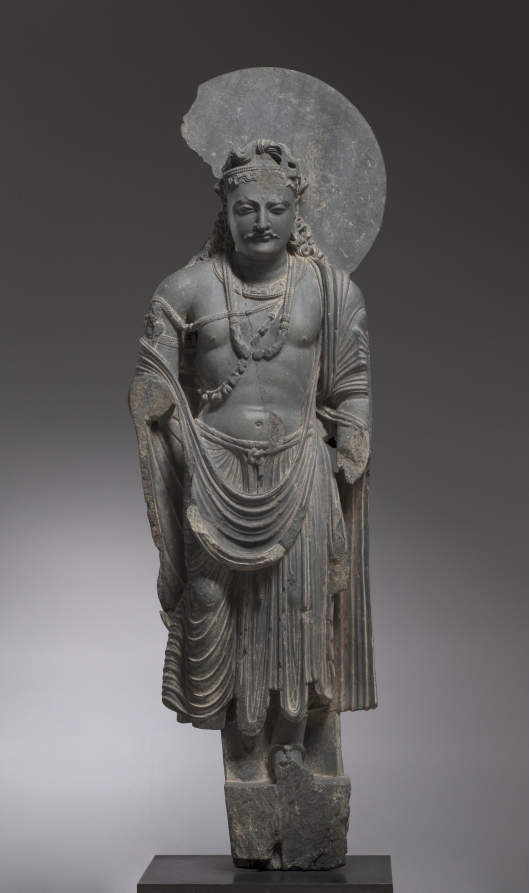
Bodhisattva (late 100s CE) is in the Cleveland Museum of Art collection.
The work and its context
The museum's open-access catalogue describes the work:
Bodhisattvas, who are one stage away from complete enlightenment, are depicted as royal figures because the Buddha himself was a prince before he renounced that life and finally achieved enlightenment. He wears elaborate jewelry, including a string of amulets diagonally across his chest. The garments are Indian, but the muscular torso is derived from Greco-Roman sources.
Object facts
- Title: Bodhisattva
- Date: late 100s CE
- Culture: Pakistan, Gandhara, Kushan period
- Type: Sculpture
- Technique: schist
- Dimensions: Overall: 132.4 cm (52 1/8 in.)
- Collection: Indian Art - Kushan, Gandhara
- Department: Indian and Southeast Asian Art
- Accession number: 1965.476
Collection credit
Purchase from the J. H. Wade Fund
Further reading listed by the museum
- The Cleveland Museum of Art. Handbook of the Cleveland Museum of Art/1966. Cleveland, OH: The Cleveland Museum of Art, 1966.
- “Art of Asia Recently Acquired by American Museums, 1965.” Archives of Asian Art, vol. 20, 1966, pp. 84–113.
- Lee, Sherman E. “Golden Anniversary Acquisitions: September 10 through October 16.” The Bulletin of the Cleveland Museum of Art, vol. 53, no. 7, 1966, pp. 181–284.
View the collection record
See the museum's photographs and full catalogue entry. Catalogue text is reproduced from the Cleveland Museum of Art's open-access data, with HTML formatting removed. This object and its supplied image are designated CC0.
Sources
More in Lifestyle
Keep reading