Bodhisattva of Compassion as Lokeshvara the Sky Flyer (Khasarpana) (late 1000s): Art, History and Details
Bodhisattva of Compassion as Lokeshvara the Sky Flyer (Khasarpana) at the Cleveland Museum of Art: late 1000s, Kaolin with traces of pigment. Explore the work's context, creator attribution and collection history.
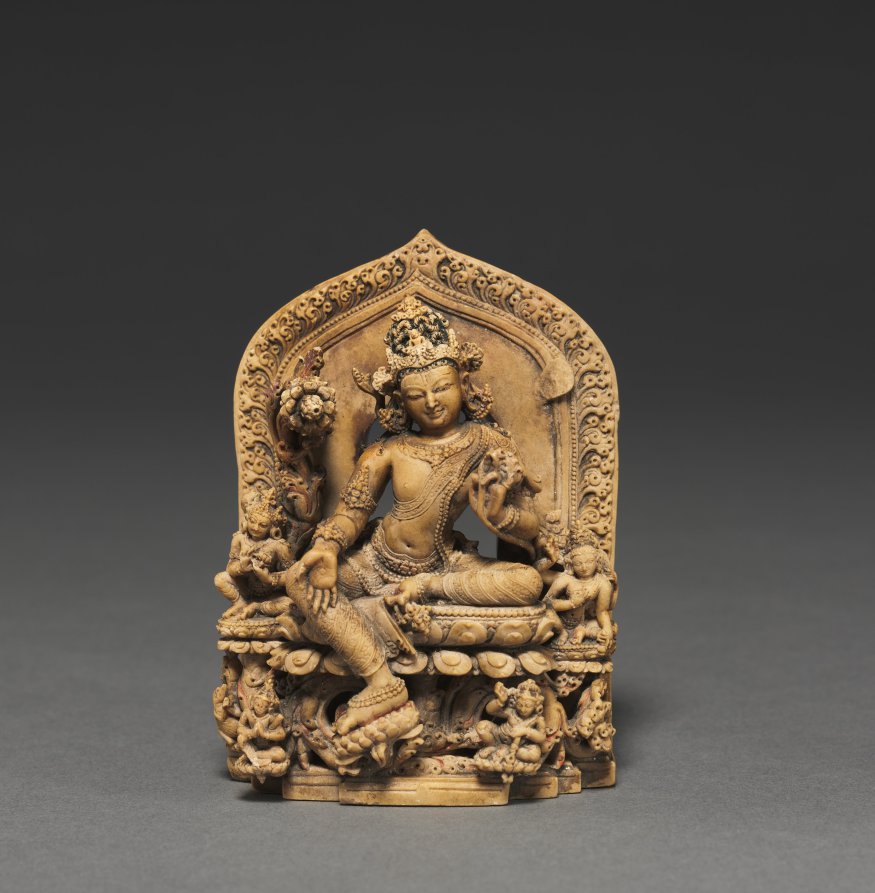
Bodhisattva of Compassion as Lokeshvara the Sky Flyer (Khasarpana) (late 1000s) is in the Cleveland Museum of Art collection.
The work and its context
The museum's open-access catalogue describes the work:
Exquisite Buddhist votive sculptures carved from soft ivorylike stone were made for personal devotional use during the 11th and 12th centuries in particular. This form of Avalokiteshvara, the powerful bodhisattva of compassion, sits with one foot down in the posture of royal ease, the Buddha Amitabha in his crown. This special form of the bodhisattva of compassion brings relief to hungry ghosts. A hungry ghost with a distended belly praises him in the lower left corner of this plaque, to the left of the tiny regal figure with a manuscript tucked in his left arm. Green Tara is at Avalokiteshvara's proper right, holding a lotus, and the four-armed goddess Bhrikuti holds a rosary and water bottle at his left.
Object facts
- Title: Bodhisattva of Compassion as Lokeshvara the Sky Flyer (Khasarpana)
- Date: late 1000s
- Culture: Eastern India, Bihar, Pala dynasty, reign of Ramapala (reign 1078/79–at least 1130)
- Type: Sculpture
- Technique: Kaolin with traces of pigment
- Dimensions: Overall: 7.7 cm (3 1/16 in.)
- Collection: Indian Art
- Department: Indian and Southeast Asian Art
- Accession number: 1991.155
A detail from the museum
When colored, Lokeshvara was white, Tara at his right knee was green, and Bhrikuti at his left knee was gold.
Collection credit
The Severance and Greta Millikin Purchase Fund
Further reading listed by the museum
- Turner, Evan H. "Selected 1991 Acquisitions." The Bulletin of the Cleveland Museum of Art 79, no. 2 (February 1992): 63–83.
- Czuma, Stanislaw J. “Some Tibetan and Tibet-Related Acquisitions of the Cleveland Museum of Art.” Oriental Art, Winter 1992/3, vol. XXXVIII no. 4, pp. 231–242.
- "Permanent Collection Installations.” Cleveland Art: Cleveland Museum of Art Members Magazine vol. 63, no. 1 (2023): 18–19.
View the collection record
See the museum's photographs and full catalogue entry. Catalogue text is reproduced from the Cleveland Museum of Art's open-access data, with HTML formatting removed. This object and its supplied image are designated CC0.
Sources
More in Lifestyle
Keep reading