Bodhisattva of Wisdom (Manjushri) (1400s): Art, History and Details
Bodhisattva of Wisdom (Manjushri) at the Cleveland Museum of Art: 1400s, Gilt bronze with precious and semiprecious stones, gum tempera, and cold gold. Explore the work's context, creator attribution and collection history.
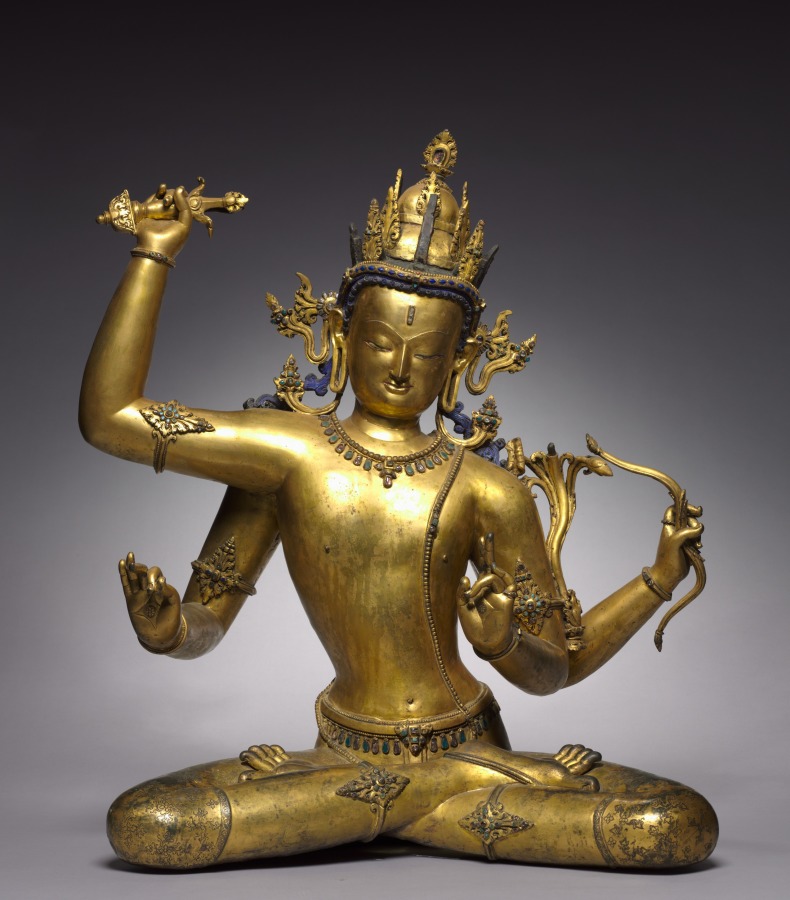
Bodhisattva of Wisdom (Manjushri) (1400s) is in the Cleveland Museum of Art collection.
The work and its context
The museum's open-access catalogue describes the work:
This image depicts one of the main bodhisattvas, beings only one stage away from full enlightenment. Because the historical Buddha was a prince prior to his renunciation and life as a wandering ascetic, bodhisattvas are depicted as royal princes. This example has the sharp features, sweet expression, and crisp details characteristic of images made in Nepal during the 1400s. In his upraised right hand Manjushri holds the hilt of a sword that, like wisdom itself, metaphorically cuts through and defeats ignorance. His lower, rear left hand grasps a bow, once probably strung with a wire. Also missing is the arrow that he likely held in his lowered right hand. Arrows were often symbols for mantras, or strings of syllables thought to have the power to focus the mind and work like missiles to destroy negativity and affliction. The gesture of his lowered left hand indicates the transmission of Buddhist teachings. The lotus stem that rises at the left elbows originally held a book of sutras. This figure is in the yogic posture of meditation with the big toe flexed in concentration. Yoga is of central importance in tantric Buddhism, because high-level practitioners are able to discipline the body to such an extent that the mind can also be controlled.
Object facts
- Title: Bodhisattva of Wisdom (Manjushri)
- Date: 1400s
- Culture: Nepal
- Type: Sculpture
- Technique: Gilt bronze with precious and semiprecious stones, gum tempera, and cold gold
- Dimensions: Overall: 78.1 x 67.6 cm (30 3/4 x 26 5/8 in.)
- Collection: Nepalese Art
- Department: Indian and Southeast Asian Art
- Accession number: 1964.370
A detail from the museum
The bodhisattva's short breeches are patterned in spiraling floral forms incised into the metal.
Collection credit
Leonard C. Hanna Jr. Fund
Further reading listed by the museum
- The Cleveland Museum of Art. Handbook of the Cleveland Museum of Art/1966. Cleveland, OH: The Cleveland Museum of Art, 1966.
- Cleveland Museum of Art, “Golden Anniversary Acquisition,” 1966, Cleveland Museum of Art Archives.
- Lee, Sherman E. “Golden Anniversary Acquisitions: September 10 through October 16.” The Bulletin of the Cleveland Museum of Art 53, no. 7 (1966): 181–284.
View the collection record
See the museum's photographs and full catalogue entry. Catalogue text is reproduced from the Cleveland Museum of Art's open-access data, with HTML formatting removed. This object and its supplied image are designated CC0.
Sources
More in Lifestyle
Keep reading