Boncompagni-Ludovisi-Ottoboni Marriage Casket (1731): Art, History and Details
Boncompagni-Ludovisi-Ottoboni Marriage Casket at the Cleveland Museum of Art: 1731, silver, partially gilt, malachite, lapis lazuli, enamel. Explore the work's context, creator attribution and collection history.
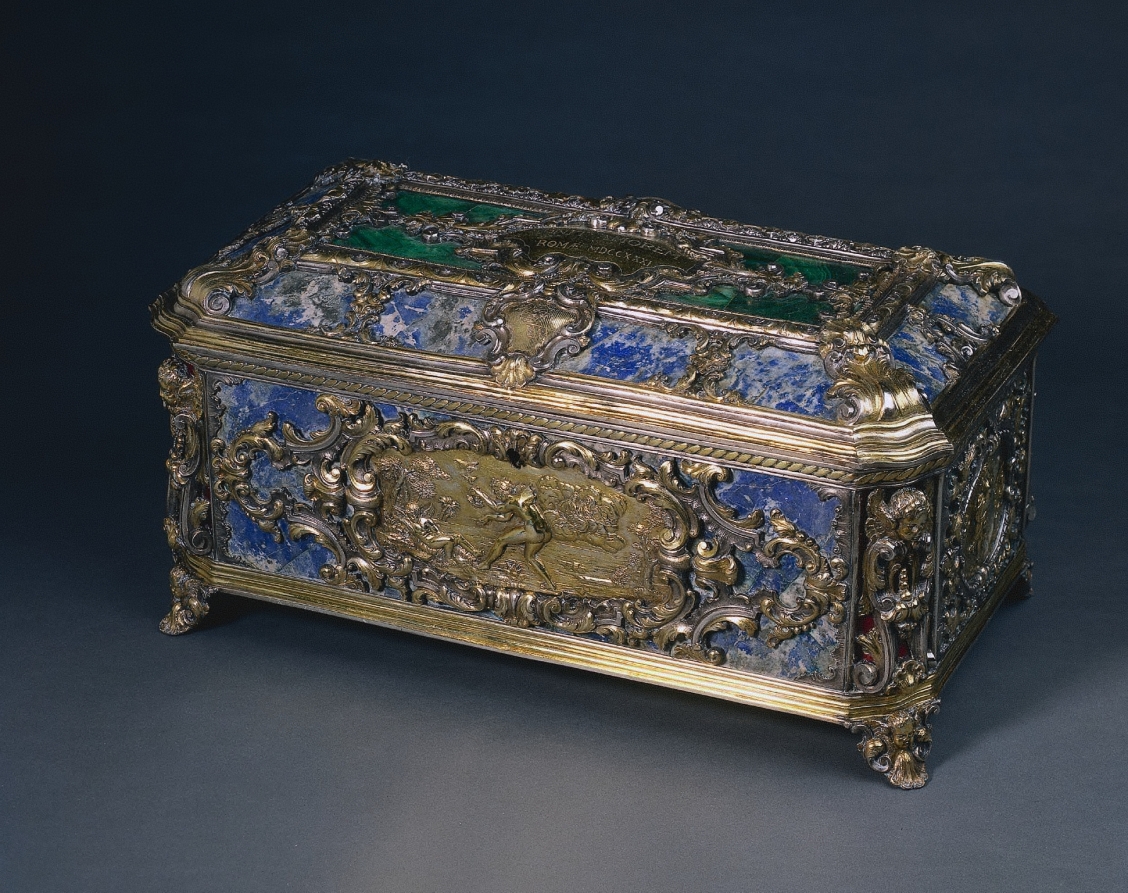
Boncompagni-Ludovisi-Ottoboni Marriage Casket (1731) is in the Cleveland Museum of Art collection.
The work and its context
The museum's open-access catalogue describes the work:
The giving of coins or other valuable items was a powerful symbol of engagement and marriage in Europe in the 1600s and 1700s. Often these valuables were presented and kept in elaborate caskets that remained the property of the wife throughout the marriage, to be drawn upon in time of need, or as a symbol of their wealth and prosperity. This silver and hardstone casket was the gift of Pier Gregorio Boncompagni Ludovisi upon his marriage to Francesca Ottoboni in 1731. Their marriage represented the merger of two very powerful Italian noble families—the Boncompagni Ludovisi from Bologna and the Ottoboni from Venice. Both families had settled in Rome in the 17th century, and each were closely aligned with the papacy, having produced numerous cardinals and popes. Appropriately adorned with scenes from the myth of Cupid and Psyche, in which the two lovers work to overcome obstacles to their marriage, the casket is a masterwork of Roman silversmithing in the Baroque taste prevalent at that time throughout Europe.
Object facts
- Title: Boncompagni-Ludovisi-Ottoboni Marriage Casket
- Date: 1731
- Culture: Italy, Rome
- Type: Silver
- Technique: silver, partially gilt, malachite, lapis lazuli, enamel
- Dimensions: Overall: 19.1 x 40.7 x 22.9 cm (7 1/2 x 16 x 9 in.)
- Collection: Decorative Arts
- Department: Decorative Art and Design
- Accession number: 1974.86
A detail from the museum
The Latin inscription on this marriage casket, "amor gignit amorem," means "love begets love," an appropriate prediction for an impending union.
Collection credit
John L. Severance Fund
Further reading listed by the museum
- Koeppe, Wolfram, Anna Maria Giusti, Cristina Acidini Luchinat, Metropolitan Museum of Art (New York, N.Y.), and Opificio delle pietre dure Museo. Art of the Royal Court : Treasures in Pietre Dure from the Palaces of Europe. New York, New Haven: Metropolitan Museum of Art ; Yale University Press, 2008.
- Lee, Sherman E. “The Year in Review for 1974.” The Bulletin of the Cleveland Museum of Art 62, no. 3 (March 1975): 62–102.
- Hawley, Henry H. “The Boncompagni-Ludovisi-Ottoboni Casket.” The Bulletin of the Cleveland Museum of Art 62, no. 7 (September 1975): 219–228.
View the collection record
See the museum's photographs and full catalogue entry. Catalogue text is reproduced from the Cleveland Museum of Art's open-access data, with HTML formatting removed. This object and its supplied image are designated CC0.
Sources
More in Lifestyle
Keep reading