Book-Shaped Reliquary (c. 1000): Art, History and Details
Book-Shaped Reliquary at the Cleveland Museum of Art: c. 1000, ivory, silver: gilded, pearls, rubies, emeralds, crystals, onyx, carnelian, oak. Explore the work's context, creator attribution and collection history.
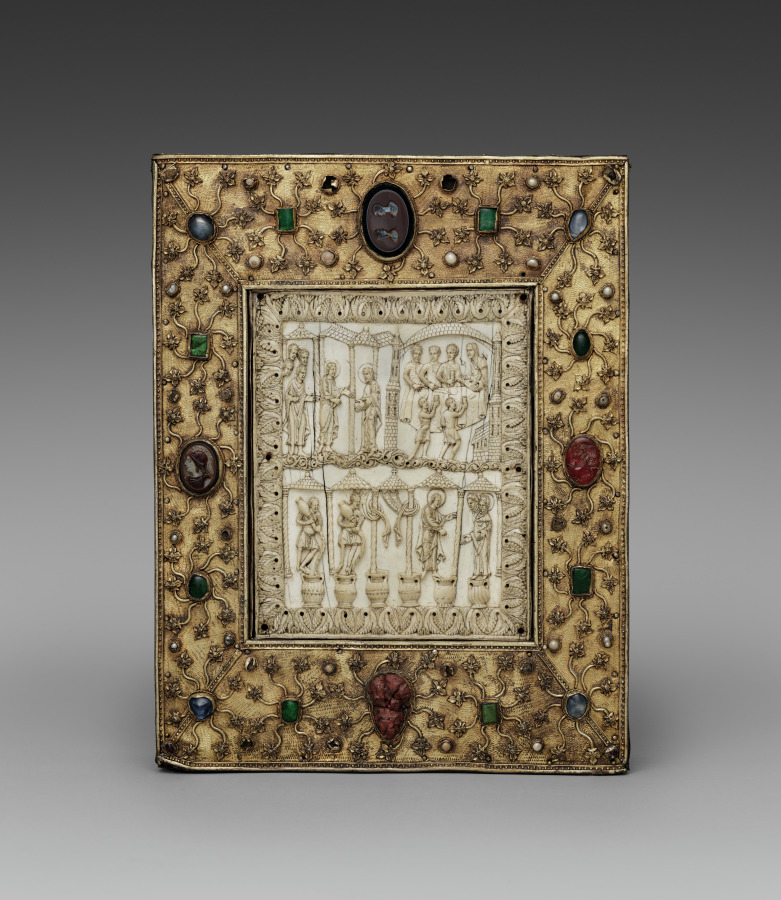
Book-Shaped Reliquary (c. 1000) is in the Cleveland Museum of Art collection. The museum's creator attribution is The Master of the Registrum Gregorii (German, active c. 972–1000).
The work and its context
The museum's open-access catalogue describes the work:
This sumptuous object closely resembles a deluxe medieval book cover in both form and decoration. It was likely commissioned by Otto the Mild, Duke of Saxony (reigned 1318–48) around 1340. It was made to contain a leaf from each gospel and relics of the 11,000 virgins and 4 other saints. These relics were originally kept in a cavity behind the delicately carved ivory plaque depicting scenes from the Wedding at Cana (John 2:1–11). The story of Christ's first miracle is presented in three scenes. In the upper left, the Virgin informs Christ and his apostles of the lack of wine at the wedding banquet. On the right, the groom, his bride, and their guests sit behind a table, two servants offering them goblets. In the lower register, two attendants pour water into the first of six storage vessels while Christ addresses his mother and the bride. The back of the reliquary shows the engraved figures of the main patron saints of Brunswick Cathedral: placed within a delicate Gothic architectural frame, Saint John the Baptist is flanked by Saints Blaise and Thomas Becket.
Object facts
- Title: Book-Shaped Reliquary
- Date: c. 1000
- Creator attribution: The Master of the Registrum Gregorii (German, active c. 972–1000)
- Culture: Ivory: Ottonian, Lorrain; Frame: Germany, Lower Saxony, Brunswick, Gothic period, 14th century
- Type: Metalwork
- Technique: ivory, silver: gilded, pearls, rubies, emeralds, crystals, onyx, carnelian, oak
- Dimensions: Overall: 31.6 x 24.4 x 7.5 cm (12 7/16 x 9 5/8 x 2 15/16 in.); Part 1: 17.8 x 14 cm (7 x 5 1/2 in.)
- Collection: MED - Gothic
- Department: Medieval Art
- Accession number: 1930.741
Collection credit
Gift of the John Huntington Art and Polytechnic Trust
Further reading listed by the museum
- Neumann, Wilhelm Anton, and Wenzel August Neumann. Der Reliquienschatz des Hauses Braundschweig-Lüneburg. Wien: Alfred Hölder, 1891.
- Goldschmidt, Adolph, Paul Gustav Hübner, and Otto Homburger. Die Elfenbeinskulpturen. Berlin: B. Cassirer, 1914.
- "The Great Guelph Treasure to go to America?" The Illustrated London News (January 12, 1929): 45.
View the collection record
See the museum's photographs and full catalogue entry. Catalogue text is reproduced from the Cleveland Museum of Art's open-access data, with HTML formatting removed. This object and its supplied image are designated CC0.
Sources
More in Lifestyle
Keep reading