Boot (907–1125): Art, History and Details
Boot at the Cleveland Museum of Art: 907–1125, Silk: tapestry weave; two kinds of metal threads. Explore the work's context, creator attribution and collection history.
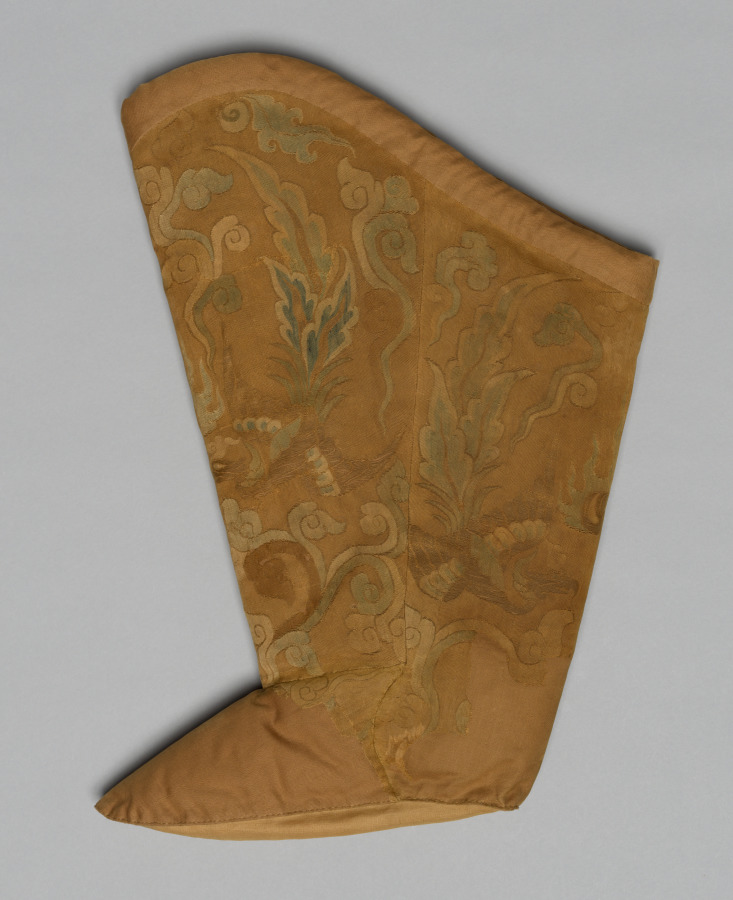
Boot (907–1125) is in the Cleveland Museum of Art collection.
The work and its context
The museum's open-access catalogue describes the work:
The kesi outer fabric of the boots is woven with pairs of phoenixes chasing a flaming pearl among clouds. The sections were carefully cut so that the flaming pearl occurs at the centers of the shin and calf, and at the top of the instep. To accommodate the particular cut and smaller area of the instep, the phoenixes were depicted slightly differently and the design was reduced in scale. The wide cut of the top of the boots enabled pants to be tucked inside. Skirts, jackets, robes, gloves, and a hat would have completed the outfit. Liao kesi is distinguished by its exceptional refinement. Considered a national specialty, it was used extensively for both clothing and furnishings. Not only were kesi robes worn by the Liao emperor, but they were sent to the Song emperor as imperial gifts.
Object facts
- Title: Boot
- Date: 907–1125
- Culture: Northern China, Liao dynasty (907-1125)
- Type: Textile
- Technique: Silk: tapestry weave; two kinds of metal threads
- Dimensions: Overall: 47.5 x 30.8 cm (18 11/16 x 12 1/8 in.)
- Collection: Textiles
- Department: Textiles
- Accession number: 1993.158.2
A detail from the museum
The once lavish use of gold and the Chinese-inspired phoenix motif suggest that the boots were made for a member of the Liao imperial family, probably a woman.
Collection credit
Purchase from the J. H. Wade Fund
Further reading listed by the museum
- “1993 Annual Report.” The Bulletin of the Cleveland Museum of Art 81, no. 6 (June 1994): 143–218.
- Watt, James C. Y, Anne E Wardwell, Anne E Wardwell, Morris Rossabi, Cleveland Museum of Art, Metropolitan Museum of Art (New York, N.Y.), Morris Rossabi, Cleveland Museum of Art, and Metropolitan Museum of Art (New York, N.Y.). When Silk Was Gold: Central Asian and Chinese Textiles. New York: Metropolitan Museum of Art in cooperation with the Cleveland Museum of Art, 1997.
- Spee, Clarissa von. "From the SIlk Road to the Imperial Court: Chinese Textiles in the Cleveland Museum of Art." Arts of Asia 48, no. 3(May-June 2018): 50-56.
View the collection record
See the museum's photographs and full catalogue entry. Catalogue text is reproduced from the Cleveland Museum of Art's open-access data, with HTML formatting removed. This object and its supplied image are designated CC0.
Sources
More in Lifestyle
Keep reading
Related stories