Border Fragment of a Shawl (early 1800s): Art, History and Details
Border Fragment of a Shawl at the Cleveland Museum of Art: early 1800s, wool: tapestry twill. Explore the work's context, creator attribution and collection history.
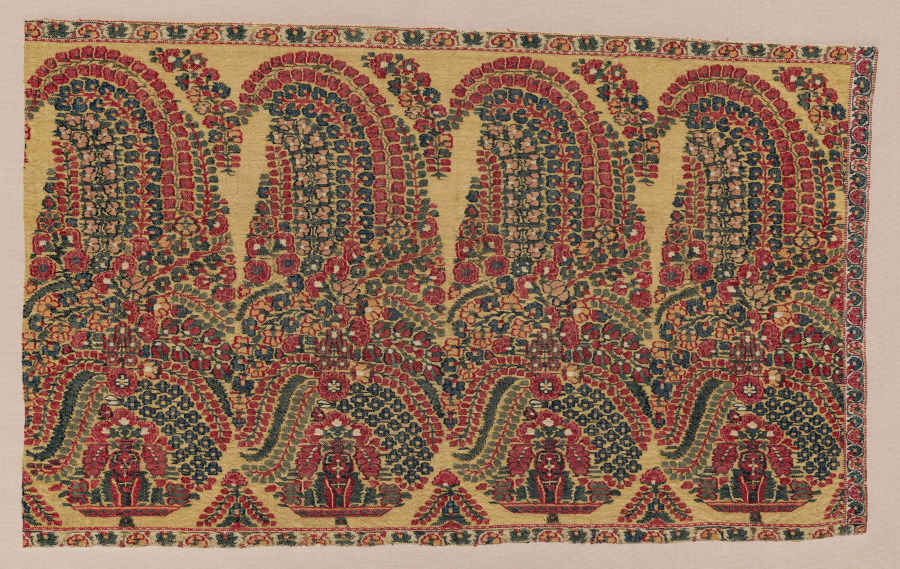
Border Fragment of a Shawl (early 1800s) is in the Cleveland Museum of Art collection.
The work and its context
The museum's open-access catalogue describes the work:
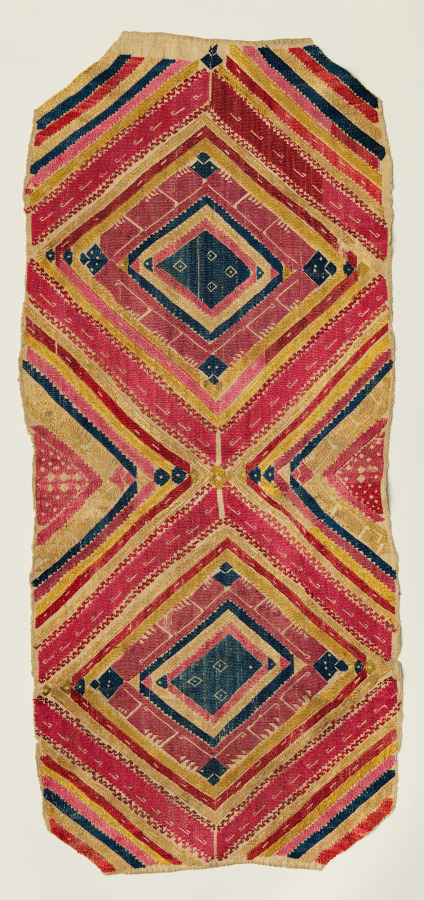
Green, yellow, red, blue, and white woolen threads were woven to create the instantly recognizable Kashmiri teardrop flower patterns on this shawl border. Such a work was part of a larger textile, which would have entranced the viewer with its complexity and vibrancy, especially as it moved with the wearer and contrasted with other articles of clothing.
Object facts
- Title: Border Fragment of a Shawl
- Date: early 1800s
- Culture: Kashmir
- Type: Textile
- Technique: wool: tapestry twill
- Dimensions: Overall: 33 x 52.7 cm (13 x 20 3/4 in.); Mounted: 20 x 70.5 cm (7 7/8 x 27 3/4 in.)
- Collection: Textiles
- Department: Textiles
- Accession number: 1934.199
A detail from the museum
The right edge of this textile features a repeating row of wild mulberries and flowers.
Collection credit
Gift of the Cleveland School of Art
Further reading listed by the museum
- Lévi-Strauss, Monique, and Massimo Listri. The Cashmere shawl. London: Dryad, 1987.
- Ames, Frank. The Kashmir Shawl and Its Indo-French Influence. Woodbridge, Suffolk: Antique Collectors' Club, 1997.
- Ames, Frank. Woven Masterpieces of Sikh Heritage: The Stylistic Development of the Kashmir Shawl Under Maharaja Ranjit Singh (1780-1839). Woodbridge, Suffolk: Antique Collectors' Club, 2010.
View the collection record
See the museum's photographs and full catalogue entry. Catalogue text is reproduced from the Cleveland Museum of Art's open-access data, with HTML formatting removed. This object and its supplied image are designated CC0.
Sources
More in Lifestyle
Keep reading