Bottle (Schraubflasche) (c. 1660–80): Art, History and Details
Bottle (Schraubflasche) at the Cleveland Museum of Art: c. 1660–80, salt-glazed stoneware, applied and impressed decoration. Explore the work's context, creator attribution and collection history.
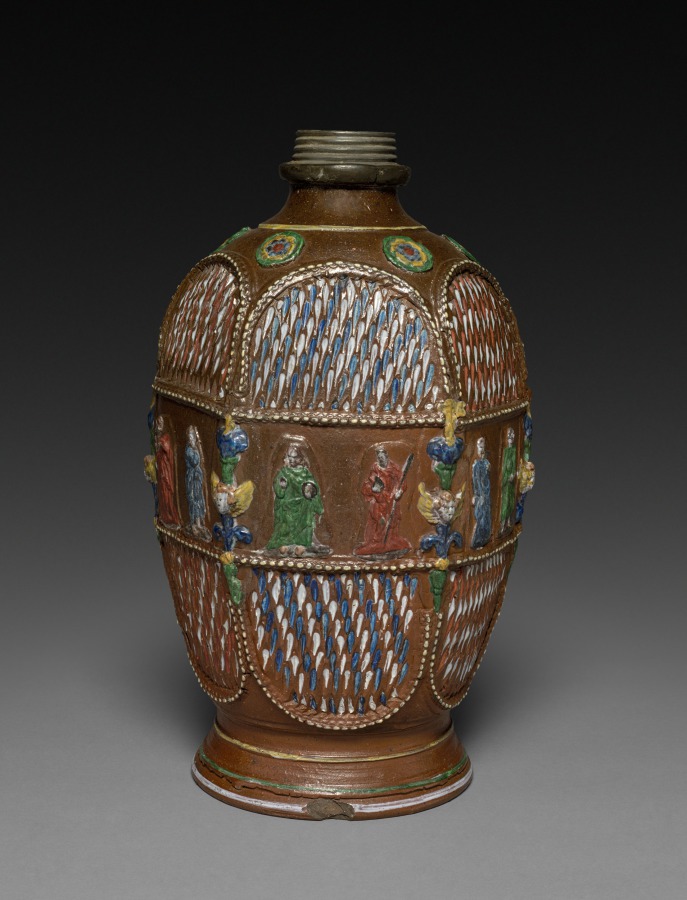
Bottle (Schraubflasche) (c. 1660–80) is in the Cleveland Museum of Art collection.
The work and its context
The museum's open-access catalogue describes the work:
Bottles or jars (kruken) of this type of six-sided form are most often associated with the ceramic tradition found in Kreussen (now Creussen) in the Bavarian region of Germany during the mid to late 1600s. With a threaded neck fitted with a pewter screw top and ring, they were ideal vessels for medicinal liquids as they could be easily connected to a belt for transport to the patient. Applied decoration depicting the twelve apostles, as on this example, allude to the spiritual nature of healing.
Object facts
- Title: Bottle (Schraubflasche)
- Date: c. 1660–80
- Culture: Germany, Bavaria, Kreussen
- Type: Ceramic
- Technique: salt-glazed stoneware, applied and impressed decoration
- Dimensions: Overall: 34.3 cm (13 1/2 in.)
- Collection: Decorative Arts
- Department: Decorative Art and Design
- Accession number: 1918.327.a
A detail from the museum
The applied decoration on this bottle depicts the twelve apostles.
Collection credit
Gift of Charles G. King Jr.
View the collection record
See the museum's photographs and full catalogue entry. Catalogue text is reproduced from the Cleveland Museum of Art's open-access data, with HTML formatting removed. This object and its supplied image are designated CC0.
Sources
More in Lifestyle
Keep reading