Bowl (early 1600s): Art, History and Details
Bowl at the Cleveland Museum of Art: early 1600s, Fritware with underglaze design in colored slips, Kubachi ware. Explore the work's context, creator attribution and collection history.
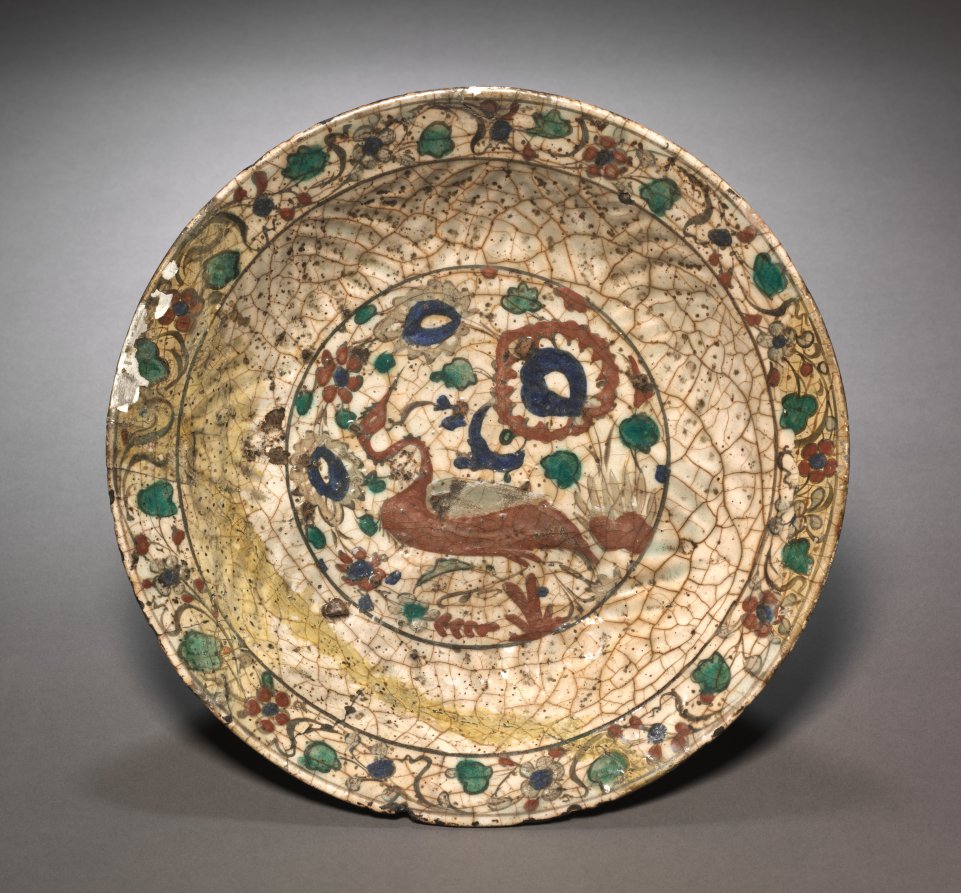
Bowl (early 1600s) is in the Cleveland Museum of Art collection.
The work and its context
The museum's open-access catalogue describes the work:
A long-legged bird, possibly a crane, is surrounded by flowers on the inside of the bowl. The rim is encircled by a band of undulating stems and flowers in red, deep blue, turquoise-green, white, and dull green-gray. The exterior features only the crackle glaze.
Object facts
- Title: Bowl
- Date: early 1600s
- Culture: Iran, Safavid period (1501–1722)
- Type: Ceramic
- Technique: Fritware with underglaze design in colored slips, Kubachi ware
- Dimensions: Overall: 8.4 x 35.6 cm (3 5/16 x 14 in.)
- Collection: Islamic Art
- Department: Islamic Art
- Accession number: 1915.594
A detail from the museum
This type of pottery is named after a town in the Caucasus, but most Kubachi wares were likely made in northwestern Iran.
Collection credit
Gift of the John Huntington Art and Polytechnic Trust
View the collection record
See the museum's photographs and full catalogue entry. Catalogue text is reproduced from the Cleveland Museum of Art's open-access data, with HTML formatting removed. This object and its supplied image are designated CC0.
Sources
More in Lifestyle
Keep reading