Bowl (wan) with Water Plants and Arabesques (1506–21): Art, History and Details
Bowl (wan) with Water Plants and Arabesques at the Cleveland Museum of Art: 1506–21, porcelain. Explore the work's context, creator attribution and collection history.
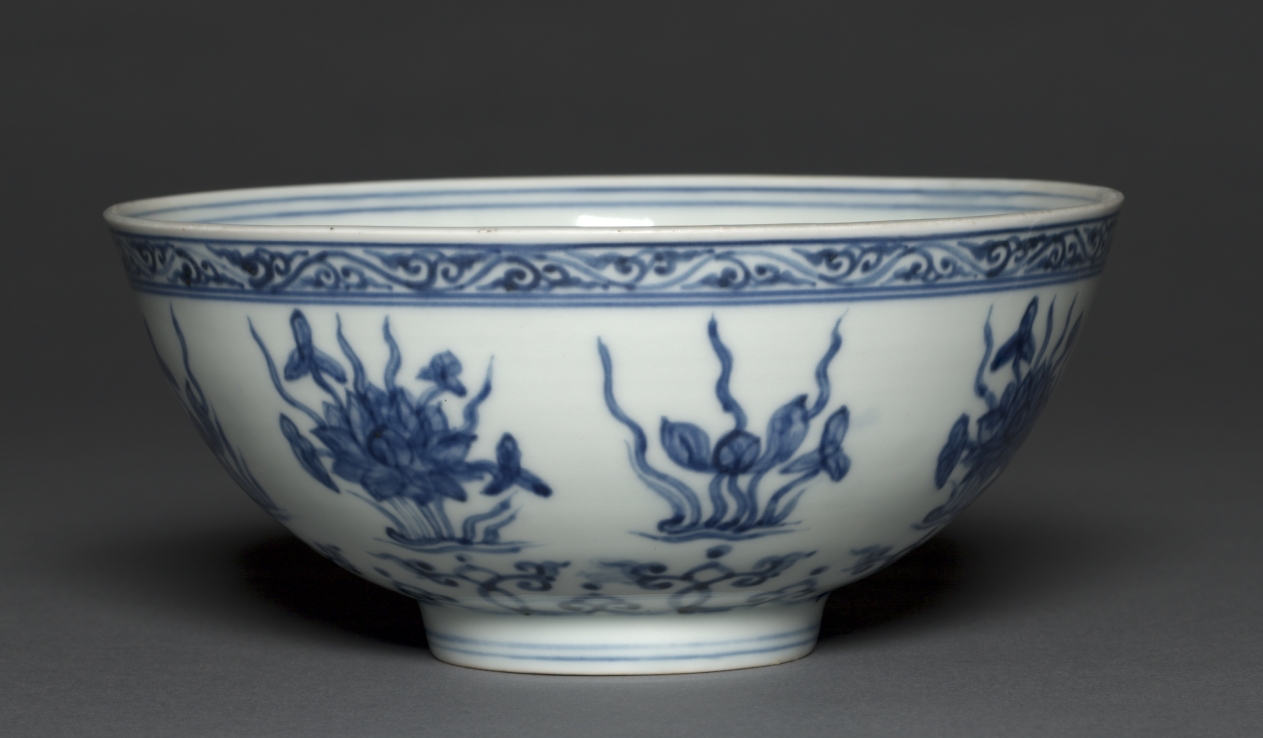
Bowl (wan) with Water Plants and Arabesques (1506–21) is in the Cleveland Museum of Art collection.
The work and its context
The museum's open-access catalogue describes the work:
Arabesques, an ornamental design of intertwined flowing lines inspired by Middle Eastern culture, appear on Chinese blue-and-white porcelain since the 1300s. The early Ming emperors, particularly the Zhengde emperor, promoted Islam and commissioned porcelain with Islamic calligraphy.
Object facts
- Title: Bowl (wan) with Water Plants and Arabesques
- Date: 1506–21
- Culture: China, Jiangxi province, Jingdezhen kilns, Ming dynasty (1368-1644), Zhengde mark and reign (1506-21)
- Type: Ceramic
- Technique: porcelain
- Dimensions: Diameter: 21.6 cm (8 1/2 in.); Overall: 9.2 cm (3 5/8 in.)
- Collection: China - Ming Dynasty
- Department: Chinese Art
- Accession number: 1957.359
A detail from the museum
Chinese potters integrated foreign motifs, shapes, and ideas in order to cater to changing tastes and new customers in an increasingly global world.
Collection credit
Anonymous Gift
Further reading listed by the museum
- Lee, Jean Gordon. “An Exhibition of Blue-Decorated Porcelain of the Ming Dynasty.” The Philadelphia Museum Bulletin, vol. 45, no. 223, 1949, pp. 1–72.
- Carswell, John, and Jean McClure Mudge. Blue and White: Chinese Porcelain and Its Impact on the Western World. Chicago: The Gallery, 1985.
View the collection record
See the museum's photographs and full catalogue entry. Catalogue text is reproduced from the Cleveland Museum of Art's open-access data, with HTML formatting removed. This object and its supplied image are designated CC0.
Sources
More in Lifestyle
Keep reading