Box and Cover with Inlaid Chrysanthemum Design (1200s): Art, History and Details
Box and Cover with Inlaid Chrysanthemum Design at the Cleveland Museum of Art: 1200s, celadon. Explore the work's context, creator attribution and collection history.
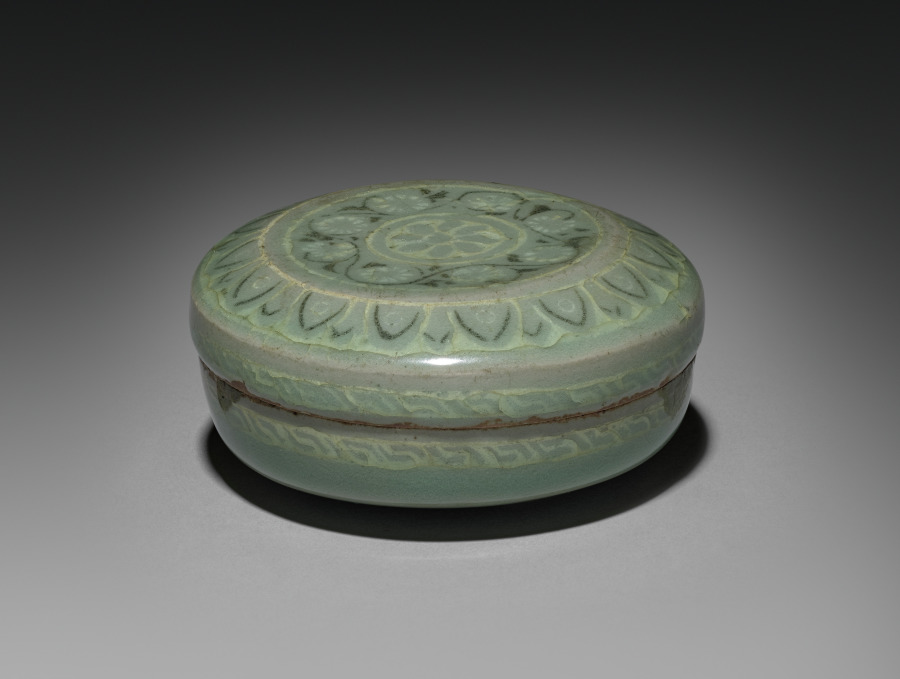
Box and Cover with Inlaid Chrysanthemum Design (1200s) is in the Cleveland Museum of Art collection.
The work and its context
The museum's open-access catalogue describes the work:
Celadons, spoons, seals, and bronze mirrors were the most common burial objects in tombs during the Goryeo period (918-1392). Once used to contain color powder, rouge and eyebrow gel for makeup, this small container was one of the standard goods that furnished elites' tombs. Goryeo-period women and men used the grain powder of rice or millet for whitening their skin, safflower extract for rouge, and plant ash or soot for eyebrow gel. Yet, natural-looking make-up seems to have been the most favorable one in Korea according to the travelogue by Xu Jing (1091-1153), the Chinese diplomat who visited Korea in 1123.
Object facts
- Title: Box and Cover with Inlaid Chrysanthemum Design
- Date: 1200s
- Culture: Korea, Goryeo dynasty (918–1392)
- Type: Ceramic
- Technique: celadon
- Dimensions: Diameter: 9.1 cm (3 9/16 in.); Overall: 4.2 cm (1 5/8 in.)
- Collection: Korean Art
- Department: Korean Art
- Accession number: 1918.423
A detail from the museum
This ceramic container was used to store incense or cosmetics.
Collection credit
Gift of John L. Severance
Further reading listed by the museum
- Lee, Young-hee. "The Study on Techniques and their Interrelations among Craft Arts of the Goryeo Dynasty [고려시대 공예기법 연구 상호관련성을 중심으로]." Misulsa hakbo 22 (2004): 133-170.
- A Chinese traveler in medieval Korea : Xu Jing's illustrated account of the Xuanhe embassy to Koryo. Translated by Sem Vermeersch. Honolulu: University of Hawaii Press, 2016.
- Goryeo Dynasty: Korea's Age of Enlightenment, 918-1392. San Francisco: Asian Art Museum, 2003.
View the collection record
See the museum's photographs and full catalogue entry. Catalogue text is reproduced from the Cleveland Museum of Art's open-access data, with HTML formatting removed. This object and its supplied image are designated CC0.
Sources
More in Lifestyle
Keep reading