Boy with Anchor (1873): Art, History and Details
Boy with Anchor at the Cleveland Museum of Art: 1873, Watercolor and graphite on paper. Explore the work's context, creator attribution and collection history.
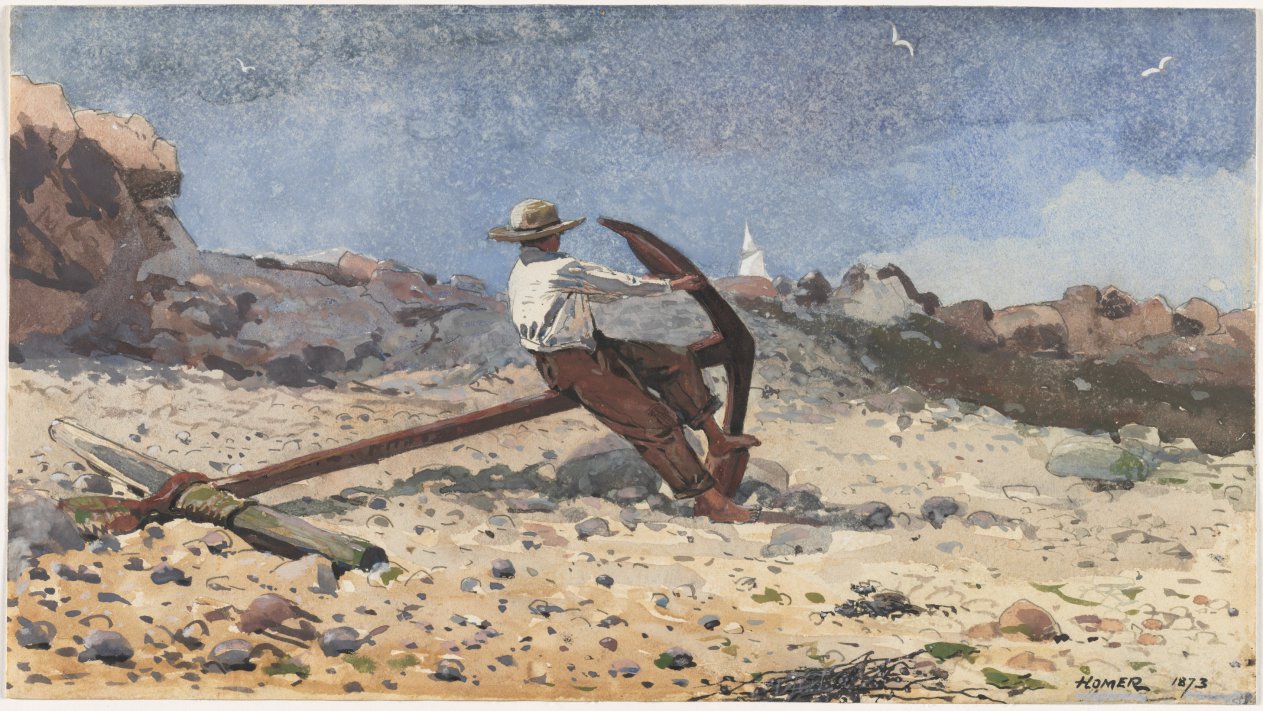
Boy with Anchor (1873) is in the Cleveland Museum of Art collection. The museum's creator attribution is Winslow Homer (American, 1836–1910).
The work and its context
The museum's open-access catalogue describes the work:
In this work from a series of watercolors produced in Gloucester, MA, in the summer of 1873 Winslow Homer evokes the fraught nature of the local fishing industry by focusing not on the perilous work of adults, but rather the children they leave behind. In Boy with Anchor, the massive anchor pointing toward the sea foreshadows the weight of the boy’s maritime destiny. The work is an early example of Homer's talent for evoking atmospheric effects and his interest in technical variety. Presumably working outdoors, Homer layered fluent washes of blue, gray, and brown transparent watercolor over his graphite underdrawing to flesh out the beach and sky. He built up the hot, pebble-studded surface of the beach by using dense gouache to draw textural detail and created the broken cloud pattern in the sky by lightly blotting his wet blue wash. The picture’s formal tensions between warm and cool colors, outline and wash, and transparency and opacity mirror the emotional tension of the scene.
Object facts
- Title: Boy with Anchor
- Date: 1873
- Creator attribution: Winslow Homer (American, 1836–1910)
- Culture: America
- Type: Drawing
- Technique: Watercolor and graphite on paper
- Dimensions: Sheet: 19.4 x 34.9 cm (7 5/8 x 13 3/4 in.)
- Collection: DR - American 19th Century
- Department: Drawings
- Accession number: 1954.128
A detail from the museum
The mottled texture of the sky is an example of Homer’s blotting technique—a subtractive process in which he applied a wash of water, sprinkled some breadcrumbs, and then gently rubbed the paper with his fingers in order to absorb the extra color, leaving behind a granulated texture.
Collection credit
Norman O. Stone and Ella A. Stone Memorial Fund
Further reading listed by the museum
- “Accessions of American and Canadian Museums, October - December, 1953.” The Art Quarterly 17, no. 2 (Summer 1954): 179-190.
- Francis, Henry S. "Recent Additions to the Collection of Homer." The Bulletin of the Cleveland Museum of Art 42, no. 3 (1955): 51-54.
- The Cleveland Museum of Art. The Cleveland Museum of Art Handbook. Cleveland, OH: The Cleveland Museum of Art, 1958.
View the collection record
See the museum's photographs and full catalogue entry. Catalogue text is reproduced from the Cleveland Museum of Art's open-access data, with HTML formatting removed. This object and its supplied image are designated CC0.
Sources
More in Lifestyle
Keep reading