Brocade with Phoenixes (1100s–1200s): Art, History and Details
Brocade with Phoenixes at the Cleveland Museum of Art: 1100s–1200s, tabby, brocaded; silk and gold thread. Explore the work's context, creator attribution and collection history.
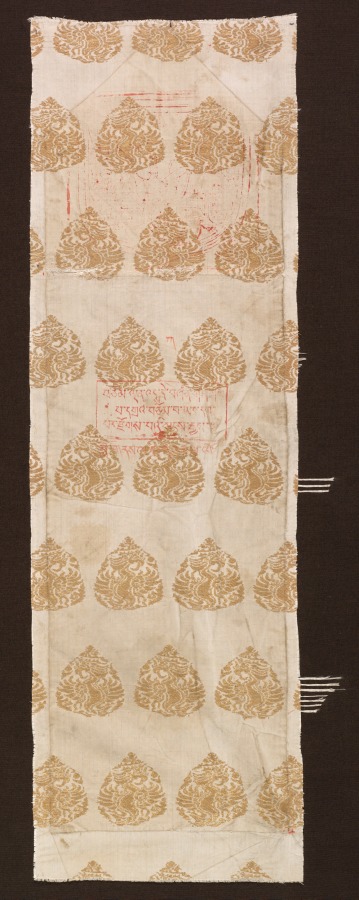
Brocade with Phoenixes (1100s–1200s) is in the Cleveland Museum of Art collection.
The work and its context
The museum's open-access catalogue describes the work:
This elegant brocade of phoenixes, seen almost frontally, is woven with gold thread made from flat strips of gilded paper instead of the usual strips of gilded parchment. This suggests that the textile was woven in the southern part of the Jin state that had been annexed from the Chinese. Although probably intended to serve as secular clothing, this textile ended up in a Buddhist institution. The end was folded and stamped in red ink with a seated Buddha flanked by two Bodhisattvas (now faint and upside down). Two Tibetan inscriptions were also stamped (translation: "The Bhagavan, the Tathagata, the Arhat, the completely perfect Buddha," and "Salutations to Blo gnas.") Above, an isolated letter ka indicates that the textile was used to cover the first volume of a set of books.
Object facts
- Title: Brocade with Phoenixes
- Date: 1100s–1200s
- Culture: Central Asia, Jin dynasty (1115–1234)
- Type: Textile
- Technique: tabby, brocaded; silk and gold thread
- Dimensions: Overall: 82 x 29.7 cm (32 5/16 x 11 11/16 in.)
- Collection: Textiles
- Department: Textiles
- Accession number: 1994.27
Collection credit
Gift of The Textile Art Alliance
Further reading listed by the museum
- Watt, James C. Y., Anne E. Wardwell, and Morris Rossabi. When silk was gold: Central Asian and Chinese textiles. New York: Metropolitan Museum of Art in cooperation with the Cleveland Museum of Art: Distributed by H.N. Abrams, 1997.
- Shea, Eiren. "The Spread of Gold Thread Production in the Mongol Period: A Study of Gold Textiles in the China National Silk Museum, Hangzhou." Journal of Song-Yuan Studies 50 (2021), 381–415.
View the collection record
See the museum's photographs and full catalogue entry. Catalogue text is reproduced from the Cleveland Museum of Art's open-access data, with HTML formatting removed. This object and its supplied image are designated CC0.
Sources
More in Lifestyle
Keep reading