Brocaded silk with foliate medallions from a kaftan (1525–75): Art, History and Details
Brocaded silk with foliate medallions from a kaftan at the Cleveland Museum of Art: 1525–75, Silk: lampas weave, silver-metal thread. Explore the work's context, creator attribution and collection history.
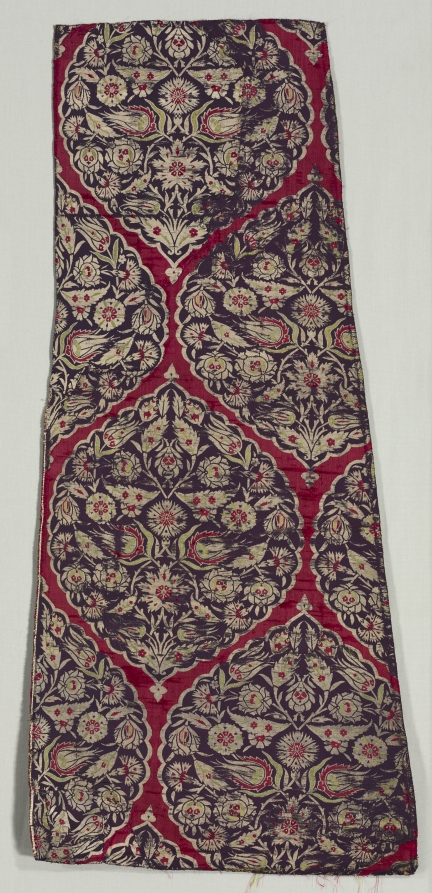
Brocaded silk with foliate medallions from a kaftan (1525–75) is in the Cleveland Museum of Art collection.
The work and its context
The museum's open-access catalogue describes the work:
Medallions enriched with floral and foliate decoration were signature Ottoman patterns during the height of silk textile production in the second half of the 1500s. Imperial kaftans with related patterns are preserved in the Topkapi Palace Museum in Istanbul along with those worn by young princes. In this splendid length from a kaftan, abundant silver-thread flora and overlapping leaves on vines enliven medallions in the densely woven fabric. It is a combination of two weaves, called lampas, which creates two contrasting surfaces composed of vertical warps and horizontal wefts.
Object facts
- Title: Brocaded silk with foliate medallions from a kaftan
- Date: 1525–75
- Culture: Turkey, Istanbul, Ottoman period
- Type: Textile
- Technique: Silk: lampas weave, silver-metal thread
- Dimensions: Overall: 105.7 x 49.5 cm (41 5/8 x 19 1/2 in.); Mounted: 110.5 x 54.6 cm (43 1/2 x 21 1/2 in.)
- Collection: T - Islamic
- Department: Textiles
- Accession number: 1924.741
Collection credit
Purchase from the J. H. Wade Fund
Further reading listed by the museum
- Mackie, Louise W. Symbols of Power: Luxury Textiles from Islamic Lands, 7th-21st Century. Cleveland; New Haven: Cleveland Museum of Art; Yale University Press, 2015.
- Mackie, Louise. "The Ottoman Sultans' Penchant for Italian Luxury Textiles." In Oriental Silks in Medieval Europe. Juliane von Fircks, and Regula Schorta, eds., 316-327. Riggisberg: Abegg-Stiftung, 2016.
View the collection record
See the museum's photographs and full catalogue entry. Catalogue text is reproduced from the Cleveland Museum of Art's open-access data, with HTML formatting removed. This object and its supplied image are designated CC0.
Sources
More in Lifestyle
Keep reading