Brocaded velvet with chintamani design (late 1400s): Art, History and Details
Brocaded velvet with chintamani design at the Cleveland Museum of Art: late 1400s, velvet, brocaded: silk and silver-metal thread. Explore the work's context, creator attribution and collection history.
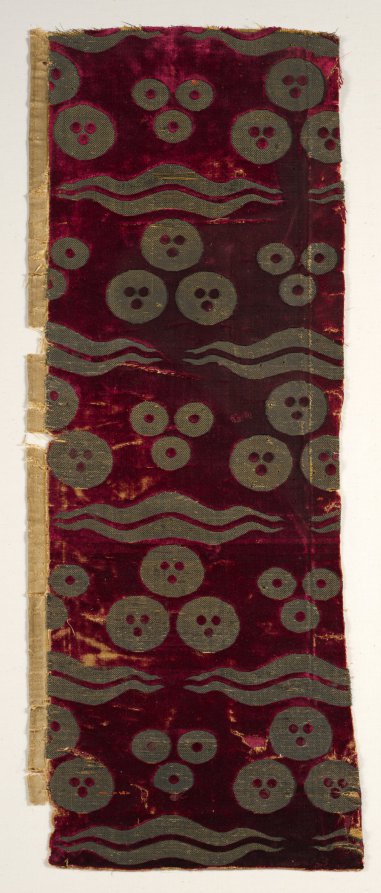
Brocaded velvet with chintamani design (late 1400s) is in the Cleveland Museum of Art collection.
The work and its context
The museum's open-access catalogue describes the work:
This early Ottoman brocaded velvet was woven in an imperial workshop in the prosperous city of Bursa, the silk capital and major commercial center of the Ottoman Empire. It has exceptionally rich crimson silk pile, almost twice as dense as later monochrome velvets. The brocaded pattern of three balls and paired wavy bands is known as chintamani, derived from the Sanskrit word for a popular Buddhist motif, “the three jewels,” shown surrounded by flames or foliage in Buddhist art across Asia. Based on the high frequency of its use in art for the Islamic court of the Ottoman Turks, it appears to have been a favored motif and possibly even an unofficial imperial emblem.
Object facts
- Title: Brocaded velvet with chintamani design
- Date: late 1400s
- Culture: Turkey, Bursa
- Type: Velvet
- Technique: velvet, brocaded: silk and silver-metal thread
- Dimensions: Overall: 81.3 x 28.6 cm (32 x 11 1/4 in.); Mounted: 91.4 x 39.4 cm (36 x 15 1/2 in.)
- Collection: T - Islamic
- Department: Textiles
- Accession number: 1943.313
Collection credit
Gift of Adolph Loewi
Further reading listed by the museum
- Mackie, Louise W. Symbols of Power: Luxury Textiles from Islamic Lands, 7th-21st Century. Cleveland; New Haven: Cleveland Museum of Art; Yale University Press, 2015.
- Mackie, Louise W. "Pomp and Grace: Ottoman Velvets of the Fifteenth Century." In Peter, Michael, and Sophie Desrosiers. Velvets of the Fifteenth Century. 2020, 175.
- Jaffer, Amin, Jasper Gaunt, and Émilie Foyer. Treasures of the Al Thani Collection at the Hôtel De La Marine. 2021.
View the collection record
See the museum's photographs and full catalogue entry. Catalogue text is reproduced from the Cleveland Museum of Art's open-access data, with HTML formatting removed. This object and its supplied image are designated CC0.
Sources
More in Lifestyle
Keep reading