Brush Washer (late 1000s–1127): Art, History and Details
Brush Washer at the Cleveland Museum of Art: late 1000s–1127, porcelaneous stoneware, Ru ware. Explore the work's context, creator attribution and collection history.
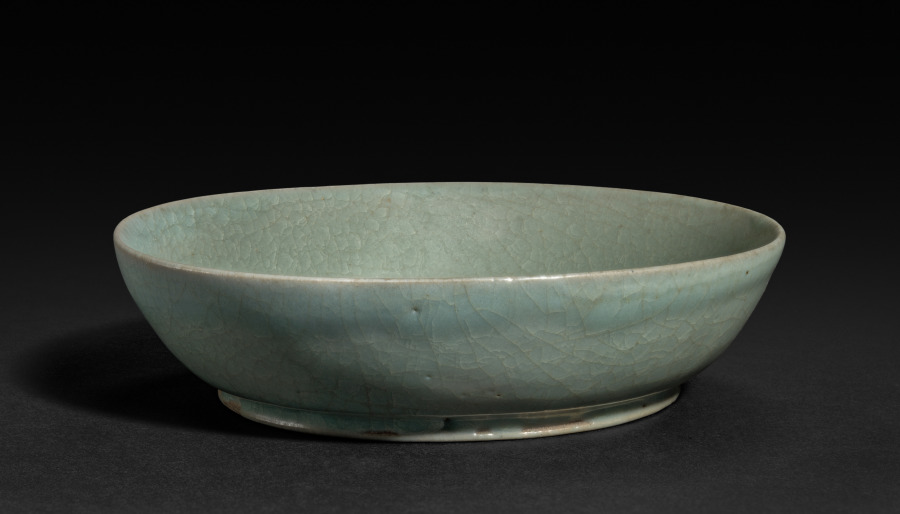
Brush Washer (late 1000s–1127) is in the Cleveland Museum of Art collection.
The work and its context
The museum's open-access catalogue describes the work:
Ru ware is the rarest and most celebrated of all Chinese imperial wares. It was made for the late Northern Song court for a very short time and was therefore extremely rare and precious. Simplicity and refined elegance are Ru ware's hallmarks. Its graceful shape, soft luster, and subtle color variation of the glaze interact in perfect unity. Other physical characteristics include an ash-grey body, soft greyblue glaze with a fine crackle, as well as small sesame-seed spur marks on the base.
Object facts
- Title: Brush Washer
- Date: late 1000s–1127
- Culture: China, Henan Province, Baofeng, Qingliangsi, Northern Song dynasty (960-1127)
- Type: Ceramic
- Technique: porcelaneous stoneware, Ru ware
- Dimensions: Diameter: 12.8 cm (5 1/16 in.); Overall: 3.8 cm (1 1/2 in.)
- Collection: China - Song Dynasty
- Department: Chinese Art
- Accession number: 1957.40
A detail from the museum
The little black spot in the glaze inside the dish is one of the slight imperfections characteristic of genuine Ru ware.
Collection credit
John L. Severance Fund
Further reading listed by the museum
- The Cleveland Museum of Art. The Cleveland Museum of Art Handbook. Cleveland, OH: The Cleveland Museum of Art, 1958.
- Lee, Sherman E. A History of Far Eastern Art. New York: H.N. Abrams, 1964.
- The Cleveland Museum of Art. Handbook of the Cleveland Museum of Art/1966. Cleveland, OH: The Cleveland Museum of Art, 1966.
View the collection record
See the museum's photographs and full catalogue entry. Catalogue text is reproduced from the Cleveland Museum of Art's open-access data, with HTML formatting removed. This object and its supplied image are designated CC0.
Sources
More in Lifestyle
Keep reading