Bull Head Attachment (c. 700–600 BCE): Art, History and Details
Bull Head Attachment at the Cleveland Museum of Art: c. 700–600 BCE, bronze. Explore the work's context, creator attribution and collection history.
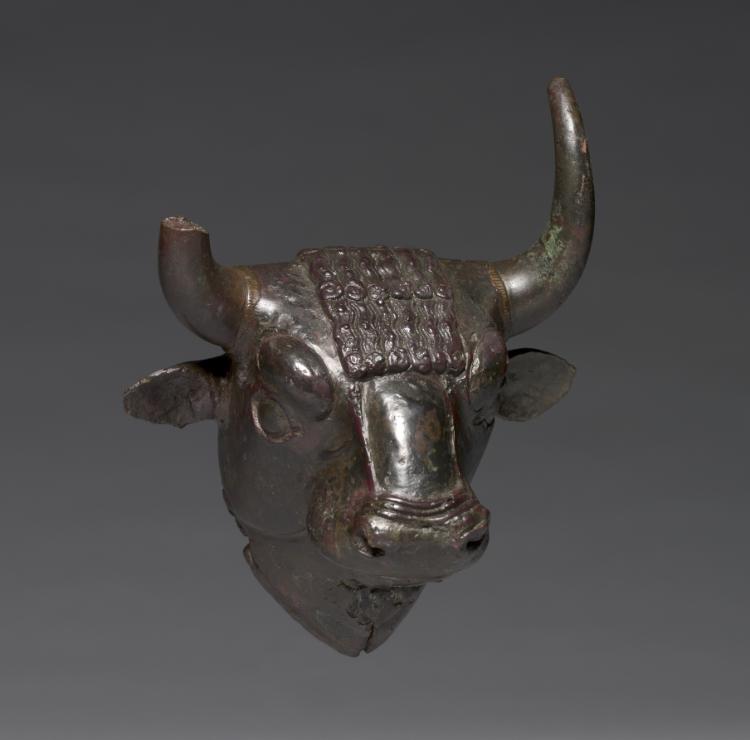
Bull Head Attachment (c. 700–600 BCE) is in the Cleveland Museum of Art collection.
The work and its context
The museum's open-access catalogue describes the work:
The kingdom of Urartu was contemporary with the Assyrian civilization. The Urartians produced elaborate bronze objects and probably passed on many of their metalwork traditions to the Achaemenian Persians. This bull head was probably one of four placed at cardinal points around the rim of a huge Urartian bronze cauldron.
Object facts
- Title: Bull Head Attachment
- Date: c. 700–600 BCE
- Culture: Urartian, northwest Iran, possibly Gusçi, Lake Urmia
- Type: Sculpture
- Technique: bronze
- Dimensions: Overall: 16.6 cm (6 9/16 in.)
- Collection: Near Eastern Art
- Department: Egyptian and Ancient Near Eastern Art
- Accession number: 1942.204
A detail from the museum
Bulls were symbols of power and fertility in many ancient cultures. This bronze bull's head was made in the kingdom of Urartu, which was located in what is Iran today, and was likely attached to the rim of a giant cauldron or cooking pot.
Collection credit
Purchase from the J. H. Wade Fund
Further reading listed by the museum
- Hollis, Howard. "An Early Persian Bull's Head." The Bulletin of the Cleveland Museum of Art 30, no. 6 (June 1943): 98-99.
- The Cleveland Museum of Art. The Cleveland Museum of Art Handbook. Cleveland, OH: The Cleveland Museum of Art, 1958.
- The Cleveland Museum of Art. Handbook of the Cleveland Museum of Art/1966. Cleveland, OH: The Cleveland Museum of Art, 1966.
View the collection record
See the museum's photographs and full catalogue entry. Catalogue text is reproduced from the Cleveland Museum of Art's open-access data, with HTML formatting removed. This object and its supplied image are designated CC0.
Sources
More in Lifestyle
Keep reading