Burial Urn with Cover (300s–500s CE): Art, History and Details
Burial Urn with Cover at the Cleveland Museum of Art: 300s–500s CE, earthenware with impressed design. Explore the work's context, creator attribution and collection history.
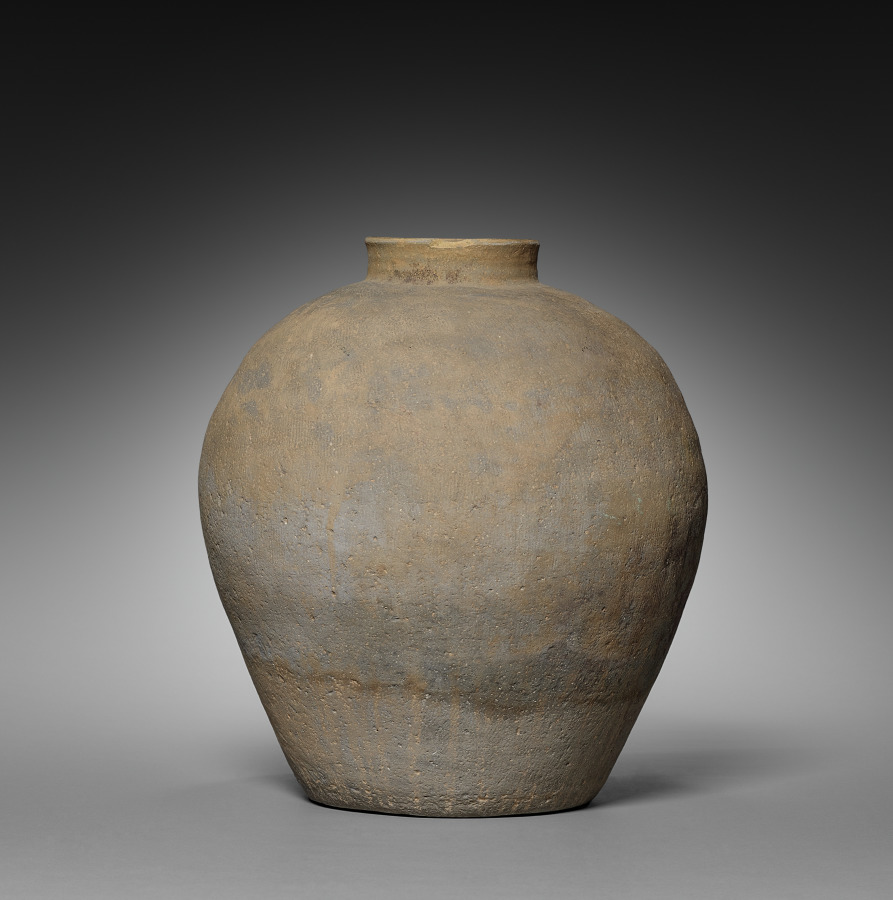
Burial Urn with Cover (300s–500s CE) is in the Cleveland Museum of Art collection.
The work and its context
The museum's open-access catalogue describes the work:
Produced in closed kilns built on hillsides during the Three Kingdoms period, this lidded jar once contained the cremated remains of the dead. This type of burial jar became widespread after the introduction of Buddhism, as cremation became a common practice in Korea.
Object facts
- Title: Burial Urn with Cover
- Date: 300s–500s CE
- Culture: Korea, Three Kingdoms period (57 BCE–668 CE)
- Type: Ceramic
- Technique: earthenware with impressed design
- Dimensions: Diameter: 42.8 cm (16 7/8 in.); Overall: 56.8 cm (22 3/8 in.)
- Collection: Korean Art
- Department: Korean Art
- Accession number: 1990.131.a
A detail from the museum
Closed kilns built on hillsides became widely used for producing this type of pottery vessel in Korea during the Three Kingdoms period.
Collection credit
John L. Severance Fund
Further reading listed by the museum
- Pottery from Ancient Korea: Clay Art for Life and Death [한국고대의토기 : 흙・예술・삶과 죽음]. Seoul: National Museum of Korea, 1997.
- Kim, Yun-jeong and 8 others. Dictionary of Korean Ceramics [한국 도자 사전]. Seoul: Gyeongin munhwasa, 2015.
- Ch'a, Mi-rae, Kwi-suk An, Cleveland Museum of Art, and 국외소재문화재재단. The Korean Collection of the Cleveland Museum of Art. Edited by An Min-hŭi. First edition, English ed. Overseas Korean Cultural Heritage Series, 16. Seoul, Republic of Korea: Overseas Korean Cultural Heritage Foundation, 2021.
View the collection record
See the museum's photographs and full catalogue entry. Catalogue text is reproduced from the Cleveland Museum of Art's open-access data, with HTML formatting removed. This object and its supplied image are designated CC0.
Sources
More in Lifestyle
Keep reading