Burial Urn with Stamped Design (500s–600s): Art, History and Details
Burial Urn with Stamped Design at the Cleveland Museum of Art: 500s–600s, stoneware with stamped designs under olive-green glaze. Explore the work's context, creator attribution and collection history.
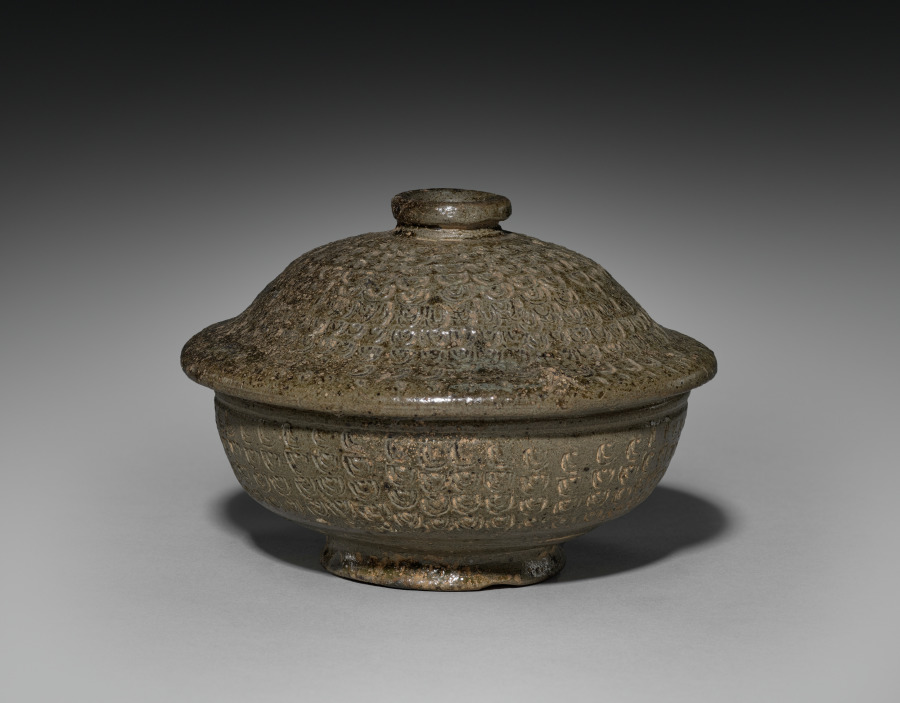
Burial Urn with Stamped Design (500s–600s) is in the Cleveland Museum of Art collection.
The work and its context
The museum's open-access catalogue describes the work:
After the introduction of Buddhism, cremation became a common practice in Korea. This jar, which once contained the remains of the dead, may have nested in a larger stone container. The repetitive patterns that appear on the lid and the container was done with a stamping technique.
Object facts
- Title: Burial Urn with Stamped Design
- Date: 500s–600s
- Culture: Korea, Unified Silla period (676-935)
- Type: Ceramic
- Technique: stoneware with stamped designs under olive-green glaze
- Dimensions: Overall: 8.1 cm (3 3/16 in.); Body: 4.4 x 10.7 cm (1 3/4 x 4 3/16 in.)
- Collection: Korean Art
- Department: Korean Art
- Accession number: 1928.178
A detail from the museum
Containing the remains of the dead, this type of ancient clay pottery was excavated from tombs.
Collection credit
Gift of John L. Severance
Further reading listed by the museum
- "Recent Additions to the Collection of Korean Pottery." The Bulletin of the Cleveland Museum of Art 15, no. 9 (November 1928): 182–184
- The Cleveland Museum of Art. Handbook of the Cleveland Museum of Art/1978. Cleveland, OH: The Cleveland Museum of Art, 1978.
- Lee, Soyoung, and Denise Patry Leidy. Silla: Korea's Golden Kingdom. New York: The Metropolitan Museum of Art, 2013.
View the collection record
See the museum's photographs and full catalogue entry. Catalogue text is reproduced from the Cleveland Museum of Art's open-access data, with HTML formatting removed. This object and its supplied image are designated CC0.
Sources
More in Lifestyle
Keep reading