Calligraphy (reverse) (late 1800s): Art, History and Details
Calligraphy (reverse) at the Cleveland Museum of Art: late 1800s, Ten-panel folding screen affixed with album leaves (obverse), calligraphy (reverse), ink and color on silk. Explore the work's context, creator attribution and collection his
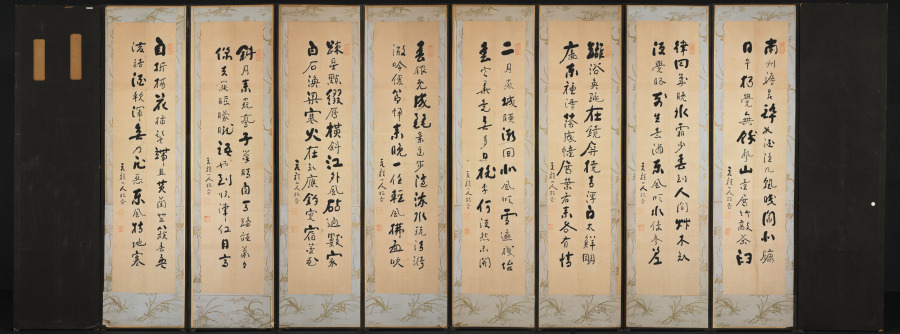
Calligraphy (reverse) (late 1800s) is in the Cleveland Museum of Art collection.
The work and its context
The museum's open-access catalogue describes the work:
The front of this screen features an assortment of subjects: birds and flowers, landscapes, and scenes of everyday life, mostly in monochromatic ink with light colors. The screen’s reverse side conveys a number of classical poems about the fleeting beauty of the four seasons. Traditionally, only one side of a folding screen bears painted or embroidered images, since these were used as a background furnishing. In Korean houses by the 1800s and early 1900s, however, two-sided folding screens became noticeably popular, possibly inspired by Japanese double-sided folding screens, which mainly served as room dividers in Japanese households.
Object facts
- Title: Calligraphy (reverse)
- Date: late 1800s
- Culture: Korea, Joseon dynasty (1392–1910)
- Type: Painting
- Technique: Ten-panel folding screen affixed with album leaves (obverse), calligraphy (reverse), ink and color on silk
- Dimensions: Image: 117.7 x 33.5 cm (46 5/16 x 13 3/16 in.); Panel: 164.5 x 43.6 cm (64 3/4 x 17 3/16 in.)
- Collection: ASIAN - Folding screen
- Department: Korean Art
- Accession number: 1998.286.b
A detail from the museum
A calligrapher has brushed several Chinese poems about the four seasons on the reverse side, among them "Composing in the Daytime of Summer" by Tang poet Liu Zongyuan (773–819) and "Composing when Spring Begins" by Song scholar Zhang Shi (1133–1180).
Collection credit
Bequest of Gordon K. Mott
Further reading listed by the museum
- Kim, Chwi-jeong. "New Trends and Japhwabyung in the Period of Modernization 개화기 화단의 신경향과 잡화병." Misulsa nondan (2008): 253-287.
- Sŏn, Sŭng-hye. The Lure of Painted Poetry: Japanese and Korean Art. Cleveland, OH: Cleveland Museum of Art, 2011.
- An, Bo-ra. "A Study of ‘Baeknapdo byungpung’ in the late Joseon period: Focus on the Example in the Collection of Boston Museum of Fine Arts 조선 말기의 百衲圖 屛風 연구: 보스턴미술관 소장본을 중심으로." Misulsa yeongu (2013): 323-351.
View the collection record
See the museum's photographs and full catalogue entry. Catalogue text is reproduced from the Cleveland Museum of Art's open-access data, with HTML formatting removed. This object and its supplied image are designated CC0.
Sources
More in Lifestyle
Keep reading