Candelabrum Stand of a Dancing Maenad (525–500 BCE): Art, History and Details
Candelabrum Stand of a Dancing Maenad at the Cleveland Museum of Art: 525–500 BCE, bronze. Explore the work's context, creator attribution and collection history.
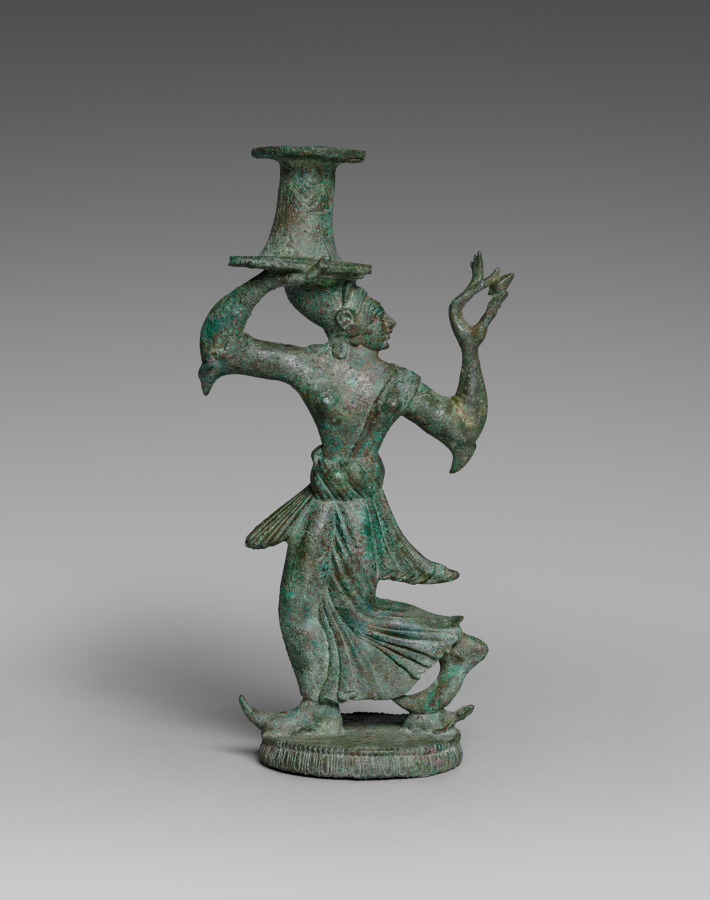
Candelabrum Stand of a Dancing Maenad (525–500 BCE) is in the Cleveland Museum of Art collection.
The work and its context
The museum's open-access catalogue describes the work:
Conceived primarily in two dimensions—front and rear silhouette—this small bronze dancer probably once belonged to an elaborate candelabra or incense burner. The exaggeratedly long fingers and pointed shoes characterize the work as Etruscan, as do the stylized folds of the figure’s dress, which add visual interest but not verisimilitude. While her right hand holds above her head a cylindrical support, her left squeezes a small object, perhaps a fruit or clapper.
Object facts
- Title: Candelabrum Stand of a Dancing Maenad
- Date: 525–500 BCE
- Culture: Etruscan
- Type: Sculpture
- Technique: bronze
- Dimensions: Overall: 18.8 cm (7 3/8 in.)
- Collection: GR - Etruscan
- Department: Greek and Roman Art
- Accession number: 1953.124
A detail from the museum
A small turtle beneath the figure’s back foot suggests a rustic setting.
Collection credit
Purchase from the J. H. Wade Fund
Further reading listed by the museum
- Weisberg, Gabriel P. Traditions and Revisions: Themes from the History of Sculpture. Cleveland: The Cleveland Museum of Art, 1975. Fig. 22.
- Art Quarterly (Winter, 1953).
- Lee, Sherman E. "An Etruscan Dancing Maenad." The Bulletin of the Cleveland Museum of Art 42, no. 8 (October 1955): 186-88.
View the collection record
See the museum's photographs and full catalogue entry. Catalogue text is reproduced from the Cleveland Museum of Art's open-access data, with HTML formatting removed. This object and its supplied image are designated CC0.
Sources
More in Lifestyle
Keep reading