Canopic Jar with Jackal's Head (lid) (664–525 BCE): Art, History and Details
Canopic Jar with Jackal's Head (lid) at the Cleveland Museum of Art: 664–525 BCE, travertine. Explore the work's context, creator attribution and collection history.
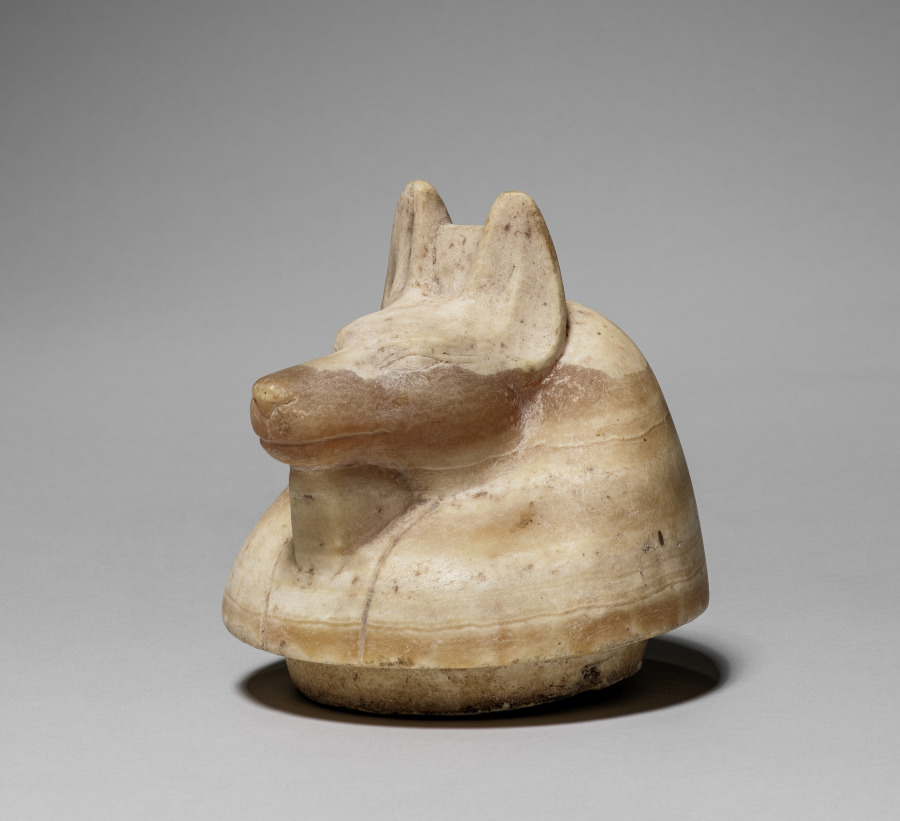
Canopic Jar with Jackal's Head (lid) (664–525 BCE) is in the Cleveland Museum of Art collection.
The work and its context
The museum's open-access catalogue describes the work:
In the process of mummification, the liver, lungs, stomach, and intestines were removed, separately embalmed, and stored in specialized jars known as canopic jars (after a sailor in Greek mythology, who died at the town of Canopus in the Nile Delta and was worshipped there in the form of a human-headed jar). Each organ was identified with one of four funerary deities collectively known as the Sons of Horus: the liver with Imsety (man's head), the lungs with Hapy (baboon's head), the stomach with Duamutef (jackal's head), and the intestines with Qebehsenuef (falcon's head). It was their duty to protect the deceased and restore to him his body parts in the hereafter.
Object facts
- Title: Canopic Jar with Jackal's Head (lid)
- Date: 664–525 BCE
- Culture: Egypt, Late period (715–332 BCE), Dynasty 26
- Type: Funerary Equipment
- Technique: travertine
- Dimensions: Diameter: 16.3 cm (6 7/16 in.); Diameter of mouth: 9 cm (3 9/16 in.); Overall: 42.6 cm (16 3/4 in.)
- Collection: Egypt - Late Period
- Department: Egyptian and Ancient Near Eastern Art
- Accession number: 1921.1021.b
A detail from the museum
This jar is made of travertine stone-- subtle in color and with a captivating natural pattern-- with hieroglyphics carved on the front. Such jars were used to hold internal organs of the deceased and to preserve them for the afterlife.
Collection credit
The Charles W. Harkness Endowment Fund
Further reading listed by the museum
- "The Bequests of Mary Warden Harkness: A Tribute and an Accounting." The Bulletin of the Cleveland Museum of Art 15, no. 2, part. 2. (February, 1928): 43-50
- Berman, Lawrence M., and Kenneth J. Bohač. Catalogue of Egyptian Art: The Cleveland Museum of Art. Cleveland, OH: Cleveland Museum of Art, 1999.
View the collection record
See the museum's photographs and full catalogue entry. Catalogue text is reproduced from the Cleveland Museum of Art's open-access data, with HTML formatting removed. This object and its supplied image are designated CC0.
Sources
More in Lifestyle
Keep reading