Canopic Jar with Lid (1540–1296 BCE): Art, History and Details
Canopic Jar with Lid at the Cleveland Museum of Art: 1540–1296 BCE, limestone. Explore the work's context, creator attribution and collection history.
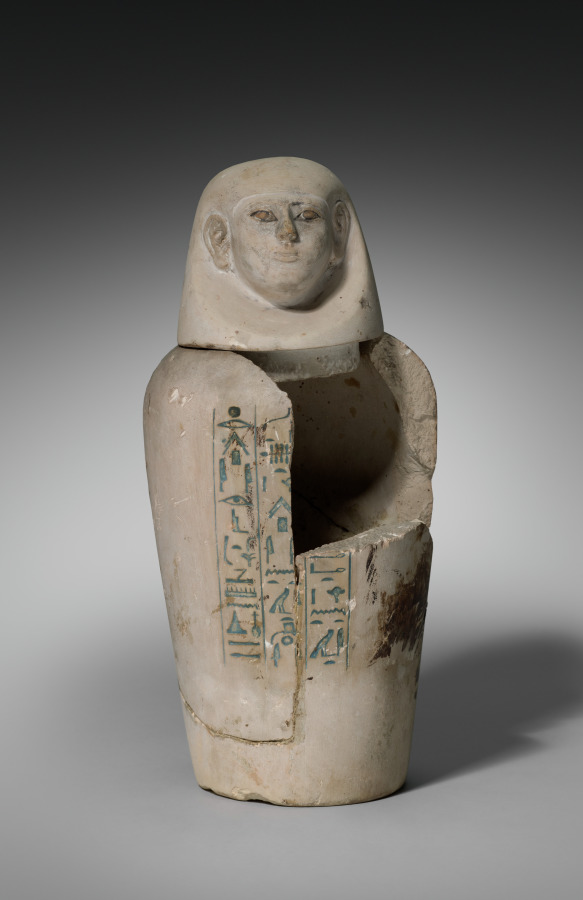
Canopic Jar with Lid (1540–1296 BCE) is in the Cleveland Museum of Art collection.
The work and its context
The museum's open-access catalogue describes the work:
In the process of mummification certain organs, the liver, lungs, stomach, and intestines, were removed, embalmed separately , and stored in jars known as canopic jars. Although this jar and another from the collection (1914.630) were presumably from the same individual and therefore the same set, they differ in their materials, workmanship, size, and style of inscriptions. Made of a different limestone this jar, the smaller of the two, has a lid in the form of a rather ludicrous male head. It is clearly by another hand. A sizable fragment is lost from the body. IN contrast to the poor quality of the head, the handsome inscription on the body is deeply cut and filled in with a blue pigment. It reads, "[Words spoken by Nephathys:] 'May your arms embrace that which is in you. May you protect Hapy, who is in you, and the honored one before Hapy, the Osiris, the royal herald, Gregmennefer, vindicated."
Object facts
- Title: Canopic Jar with Lid
- Date: 1540–1296 BCE
- Culture: Egypt, New Kingdom (1540–1069 BCE), Dynasty 18
- Type: Funerary Equipment
- Technique: limestone
- Dimensions: Diameter: 18.4 cm (7 1/4 in.); Diameter of mouth: 10.2 cm (4 in.); Overall: 39.7 cm (15 5/8 in.)
- Collection: Egypt - New Kingdom
- Department: Egyptian and Ancient Near Eastern Art
- Accession number: 1914.631
A detail from the museum
Canopic jars are named after the Greek sailor Canopus, who was said to be buried at Canopus (Abuqir) in the western delta and worshipped there in the form of a human-headed jar. It was actually a form of Osiris and had nothing to do with internal organs, but the term has stuck.
Collection credit
Gift of the John Huntington Art and Polytechnic Trust
Further reading listed by the museum
- Cleveland Museum of Art. Catalogue of the Inaugural Exhibition June 6-September 20, 1916. Cleveland: The Cleveland Museum of Art, 1916.
- Williams, Caroline Ransom. "The Egyptian Collection in the Museum of Art at Cleveland, OH," Journal of East Asian Archaeology 5 (1918).
- Berman, Lawrence M., and Kenneth J. Bohač. Catalogue of Egyptian Art: The Cleveland Museum of Art. Cleveland, OH: Cleveland Museum of Art, 1999
View the collection record
See the museum's photographs and full catalogue entry. Catalogue text is reproduced from the Cleveland Museum of Art's open-access data, with HTML formatting removed. This object and its supplied image are designated CC0.
Sources
More in Lifestyle
Keep reading
Related stories


