Canteen with a Katsina-like Face (1890): Art, History and Details
Canteen with a Katsina-like Face at the Cleveland Museum of Art: 1890, ceramic, slip. Explore the work's context, creator attribution and collection history.
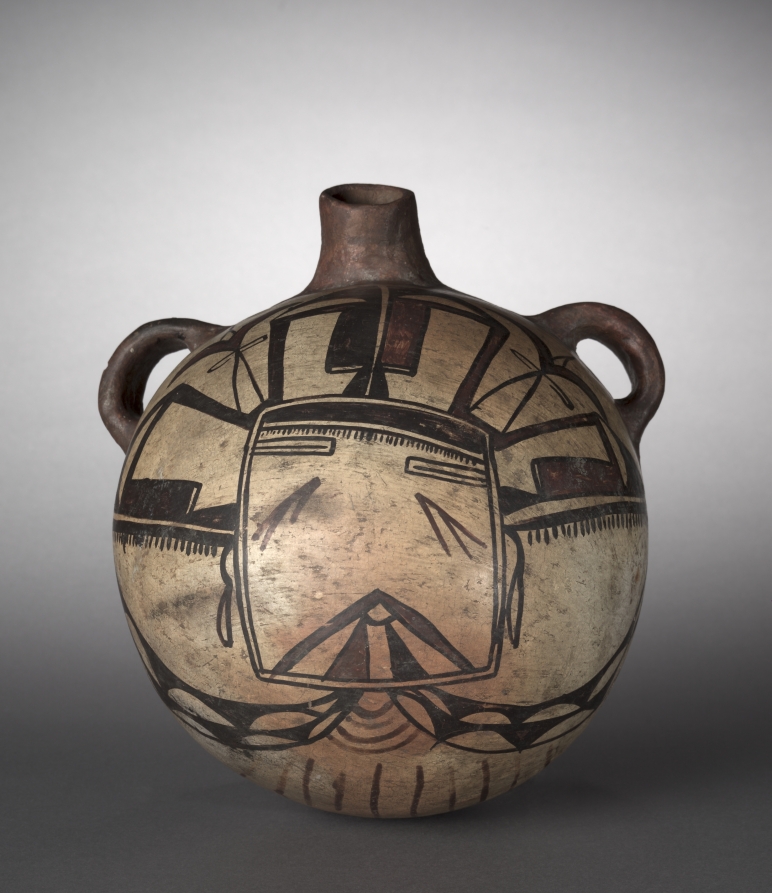
Canteen with a Katsina-like Face (1890) is in the Cleveland Museum of Art collection.
The work and its context
The museum's open-access catalogue describes the work:
Since the 1500s, Hopi women made big-bellied canteens, based on Spanish prototypes, and used them to carry water. By the late 1800s, canteens became popular with Euro-American tourists, who increasingly flocked to the Southwest in search of encounters with “exotic” Native American cultures. Thus, Hopi artists embellished their wares to improve their appeal. This example is painted with a face similar to a Katsina’s, a spirit being central to Pueblo religion—but it is a fanciful rendition, not an actual Katsina. Could the maker have been taking control of her culture and its consumption by outsiders?
Object facts
- Title: Canteen with a Katsina-like Face
- Date: 1890
- Culture: Native North America, Southwest, Arizona, Pueblo, Hopi
- Type: Ceramic
- Technique: ceramic, slip
- Dimensions: Overall: 21.5 x 24.5 cm (8 7/16 x 9 5/8 in.)
- Collection: AA - Native North America
- Department: Art of the Americas
- Accession number: 1937.708
Collection credit
Gift of Amelia Elizabeth White
View the collection record
See the museum's photographs and full catalogue entry. Catalogue text is reproduced from the Cleveland Museum of Art's open-access data, with HTML formatting removed. This object and its supplied image are designated CC0.
Sources
More in Lifestyle
Keep reading

![Tetradrachm: Head of Alexander III [The Great] (obverse); Athena (reverse) (306 BCE; Cleveland 1916.994)](https://openaccess-cdn.clevelandart.org/1916.994/1916.994_web.jpg)