Carpet (1800–1850): Art, History and Details
Carpet at the Cleveland Museum of Art: 1800–1850, Undyed wool: ground warp; dark brown wool: ground weft; dyed wool (polychrome): Ghiordes knotted pile. Explore the work's context, creator attribution and collection history.
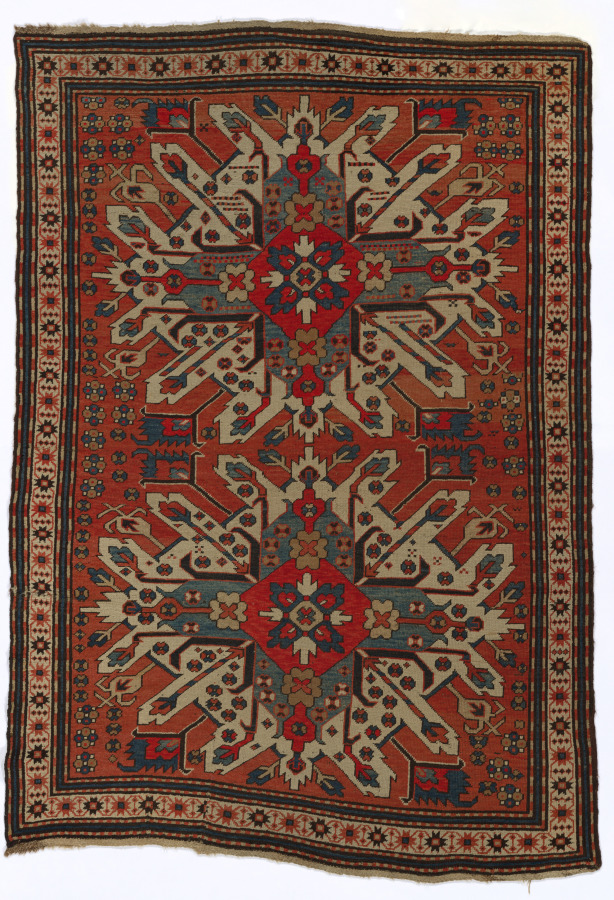
Carpet (1800–1850) is in the Cleveland Museum of Art collection.
The work and its context
The museum's open-access catalogue describes the work:
Nomadic groups, who moved across the grasslands and steppes between the Caucasus regions near the Caspian Sea to Central Asia and China, perfected the making of textiles, carpets, and other movable works of art. Carpets were woven from sheep’s wool to be strong and thick, and served as protection from the elements. This example is decorated with a double geometric sunburst motif.
Object facts
- Title: Carpet
- Date: 1800–1850
- Type: Carpet
- Technique: Undyed wool: ground warp; dark brown wool: ground weft; dyed wool (polychrome): Ghiordes knotted pile
- Dimensions: Overall: 219.4 x 154.9 cm (86 3/8 x 61 in.)
- Collection: Textiles
- Department: Textiles
- Accession number: 1989.473
Collection credit
Gift of Charles and Irma Wilkinson in honor of Evan and Brenda Turner
Further reading listed by the museum
- Diman, Maurice S., Peasant and Nomad Rugs of Asia. New York, 1961. p. 79, ill. p. 63, cat. 19.
- "Year in Review: Selestions 1989," CMA Bulletin 77 n.2 (Feb. 1990): p.77, illus p.70.
- Asia House Gallery, and Maurice Sven Dimand. Peasant and Nomad Rugs of Asia. New York: The Gallery, 1961.
View the collection record
See the museum's photographs and full catalogue entry. Catalogue text is reproduced from the Cleveland Museum of Art's open-access data, with HTML formatting removed. This object and its supplied image are designated CC0.
Sources
More in Lifestyle
Keep reading