Celestial Musician (1300s): Art, History and Details
Celestial Musician at the Cleveland Museum of Art: 1300s, silk and gold thread over two layers of cotton, embroidery. Explore the work's context, creator attribution and collection history.
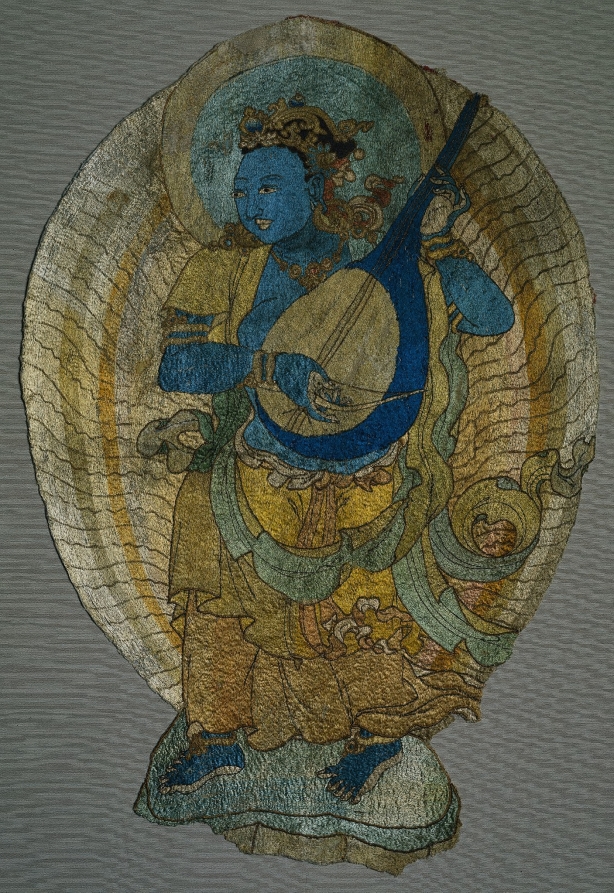
Celestial Musician (1300s) is in the Cleveland Museum of Art collection.
The work and its context
The museum's open-access catalogue describes the work:
Although a number of Buddhist textiles produced in the Sino-Tibetan style survive, Central Asian embroideries from the same period are exceedingly rare. Here, a goddess standing on a lotus support and playing a bowed lute may be the personification of the sense of hearing. In Buddhism, the five senses were represented as female deities, each a different color (in this case, blue). The style of the figure, her hair, the form of her crown, the nervously ruffled hem, the scrolling scarves, and the rainbow halo with rays are Central Asian. This figure originally was part of a large hanging.
Object facts
- Title: Celestial Musician
- Date: 1300s
- Culture: Central Asia
- Type: Embroidery
- Technique: silk and gold thread over two layers of cotton, embroidery
- Dimensions: Overall: 66.5 x 45 cm (26 3/16 x 17 11/16 in.)
- Collection: Textiles
- Department: Textiles
- Accession number: 1987.145
Collection credit
John L. Severance Fund
Further reading listed by the museum
- Watt, James C. Y., Anne E. Wardwell, and Morris Rossabi. When silk was gold: Central Asian and Chinese textiles. 1997.
- "Highlights from North American Collections." IDP News: Newsletter of the International Dunhuang Project, no. 49-50, Summer 2017, pp. 4-7.
View the collection record
See the museum's photographs and full catalogue entry. Catalogue text is reproduced from the Cleveland Museum of Art's open-access data, with HTML formatting removed. This object and its supplied image are designated CC0.
Sources
More in Lifestyle
Keep reading