Ceres and Bacchus (1600s): Art, History and Details
Ceres and Bacchus at the Cleveland Museum of Art: 1600s, oil on canvas. Explore the work's context, creator attribution and collection history.
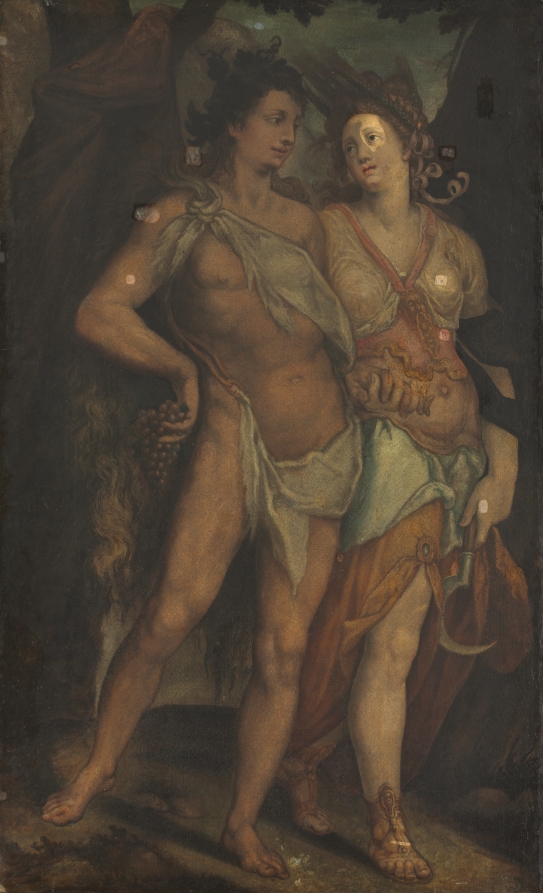
Ceres and Bacchus (1600s) is in the Cleveland Museum of Art collection. The museum's creator attribution is Bartholomaeus Spranger (Flemish, 1546–1611).
The work and its context
The museum's open-access catalogue describes the work:
This painting is a copy of a print by Jan Harmensz Muller (Dutch, 1571–1628), originally based on a painting by Spranger. Spranger often used the iconography of Ceres and Bacchus, two important agricultural deities. Muller's print has the Latin inscription Sine Cerere et Bacchio friget Venus, which translates to "without Ceres and Bacchus, Venus grows cold." The motto indicates that Love, represented by Venus, is impossible without the nourishment of food and drink, as the deities of grain and wine walk hand in hand.
Object facts
- Title: Ceres and Bacchus
- Date: 1600s
- Creator attribution: Bartholomaeus Spranger (Flemish, 1546–1611)
- Culture: Flanders
- Type: Painting
- Technique: oil on canvas
- Dimensions: Framed: 197.2 x 133.7 x 9.5 cm (77 5/8 x 52 5/8 x 3 3/4 in.); Unframed: 163.5 x 100 cm (64 3/8 x 39 3/8 in.)
- Collection: P - Netherlandish-Flemish
- Department: European Painting and Sculpture
- Accession number: 1916.805
Collection credit
Holden Collection
Further reading listed by the museum
- The Cleveland Museum of Art. The Cleveland Museum of Art Catalogue of Paintings, Part 3: European Paintings of the 16th, 17th, and 18th Centuries. Cleveland, OH: The Cleveland Museum of Art, 1982.
View the collection record
See the museum's photographs and full catalogue entry. Catalogue text is reproduced from the Cleveland Museum of Art's open-access data, with HTML formatting removed. This object and its supplied image are designated CC0.
Sources
More in Lifestyle
Keep reading


