Chest for Storing Garments (1400s): Art, History and Details
Chest for Storing Garments at the Cleveland Museum of Art: 1400s, lacquered wood with mother-of-pearl inlay. Explore the work's context, creator attribution and collection history.
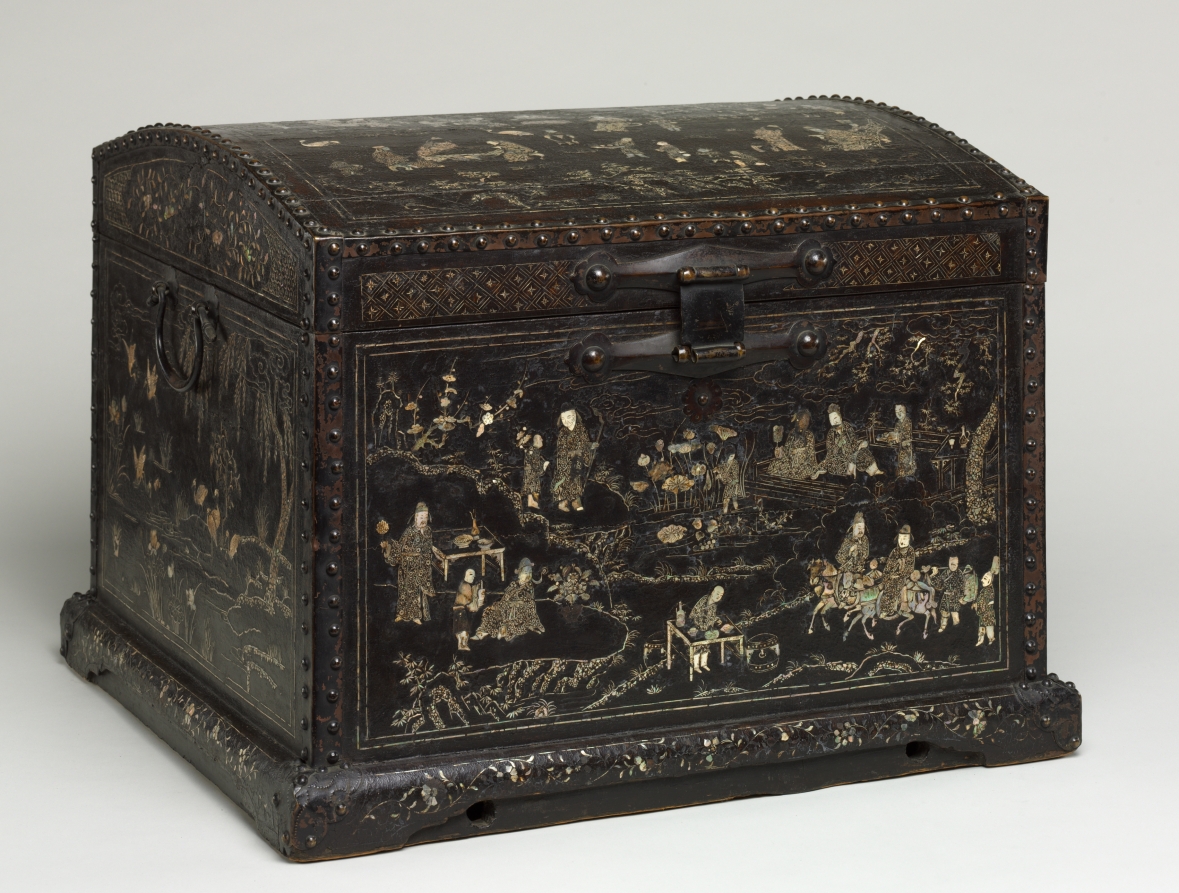
Chest for Storing Garments (1400s) is in the Cleveland Museum of Art collection.
The work and its context
The museum's open-access catalogue describes the work:
This precious lacquer box is decorated with bird and plant motifs and figures in mother-of-pearl inlay. The decoration depicts the leisurely pursuit of scholars in nature and a garden setting. Scholars play the board game weiqi, have philosophical conversations, pluck a qin (a zither-like instrument with strings), and read books. Lacquer chests of this type were used to store garments neatly folded along their straight seams. The mother-of-pearl inlay from shells is a technique that was typically practiced by craftsmen in Hangzhou and other parts of southeast China near the sea.
Object facts
- Title: Chest for Storing Garments
- Date: 1400s
- Culture: China, Ming dynasty (1368–1644)
- Type: Lacquer
- Technique: lacquered wood with mother-of-pearl inlay
- Dimensions: Overall: 43 x 56 x 54.7 cm (16 15/16 x 22 1/16 x 21 9/16 in.)
- Collection: China - Ming Dynasty
- Department: Chinese Art
- Accession number: 1975.10
A detail from the museum
Lacquer chests of this type were used to store garments.
Collection credit
Andrew R. and Martha Holden Jennings Fund
Further reading listed by the museum
- Lee, Sherman E. "The Year in Review for 1975." The Bulletin of the Cleveland Museum of Art 63, no. 2 (February 1976): 31–71.
- “Annual Report for 1975.” The Bulletin of the Cleveland Museum of Art 63, no. 6 (June 1976): 154–198.
- Guo li gu gong bo wu yuan [National Palace Museum = 國立故宮博物院]. Hai wai yi zhen. Qi qi [Chinese art in overseas collections. Lacquerware = 海外遺珎. 漆器]. Taibei Shi Shilin qu Waishuangxi: Guo li gu gong bo wu yuan, 1987.
View the collection record
See the museum's photographs and full catalogue entry. Catalogue text is reproduced from the Cleveland Museum of Art's open-access data, with HTML formatting removed. This object and its supplied image are designated CC0.
Sources
More in Lifestyle
Keep reading