Christ Carrying the Cross (Panel from an Altarpiece) (1400s): Art, History and Details
Christ Carrying the Cross (Panel from an Altarpiece) at the Cleveland Museum of Art: 1400s, painted and gilded alabaster. Explore the work's context, creator attribution and collection history.
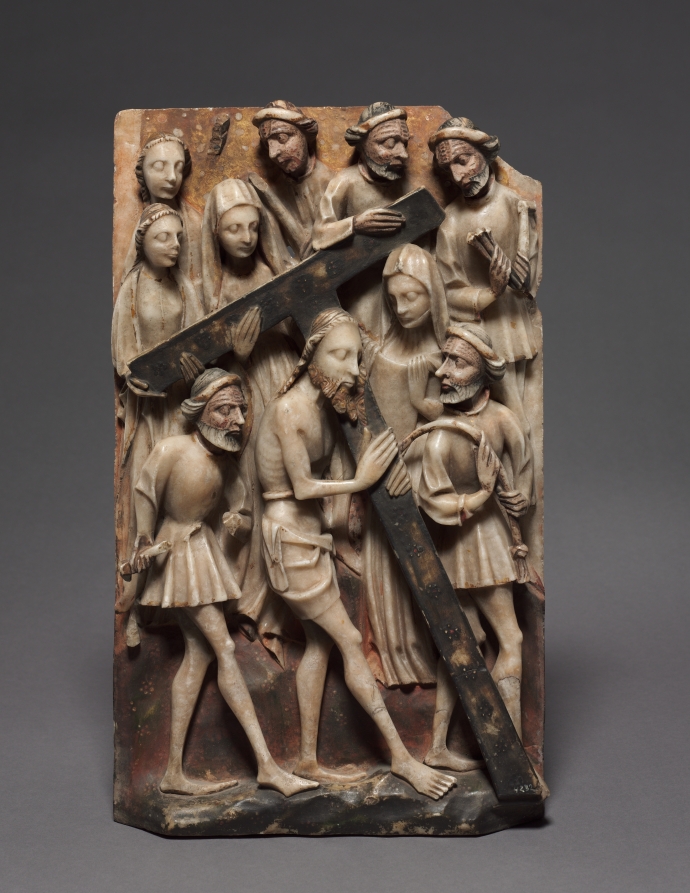
Christ Carrying the Cross (Panel from an Altarpiece) (1400s) is in the Cleveland Museum of Art collection.
The work and its context
The museum's open-access catalogue describes the work:
This panel, most likely one of five narrative scenes representing the Passion of Christ, comes from a now dismembered altarpiece. The central panel was undoubtedly a scene of the Crucifixion. Such carvings in alabaster were frequently painted in vibrant colors with added gilding. The flesh areas of the figures were often left unpainted, with the exception of villains and executioners whose faces were "blackened," as in this example, a convention that may derive from the medieval stage. English alabaster sculptures were in high demand throughout Europe during the 1300s and 1400s, and exported to Portugal, Spain, Scandinavia, Iceland, and other countries. A soft stone suitable only for interior sculpture, English alabaster was highly prized for its creamy translucency. Of the English quarries, those near Nottingham in the Midlands were the most active.
Object facts
- Title: Christ Carrying the Cross (Panel from an Altarpiece)
- Date: 1400s
- Culture: England, Nottingham, 15th century
- Type: Sculpture
- Technique: painted and gilded alabaster
- Dimensions: Overall: 47 x 28.3 cm (18 1/2 x 11 1/8 in.)
- Collection: MED - Renaissance
- Department: Medieval Art
- Accession number: 1969.296
Collection credit
Andrew R. and Martha Holden Jennings Fund
Further reading listed by the museum
- “Annual Report for 1969.” The Bulletin of the Cleveland Museum of Art 57, no. 6 (June 1970): 163–193.
- Gertsman, Elina and Barbara H. Rosenwein. The Middle Ages in 50 Objects. Cambridge: Cambridge University Press, 2018.
View the collection record
See the museum's photographs and full catalogue entry. Catalogue text is reproduced from the Cleveland Museum of Art's open-access data, with HTML formatting removed. This object and its supplied image are designated CC0.
Sources
More in Lifestyle
Keep reading