Christ Crucified Between the Two Thieves: 'The Three Crosses' (1653-c.1660): Art, History and Details
Christ Crucified Between the Two Thieves: 'The Three Crosses' at the Cleveland Museum of Art: 1653-c.1660, drypoint. Explore the work's context, creator attribution and collection history.
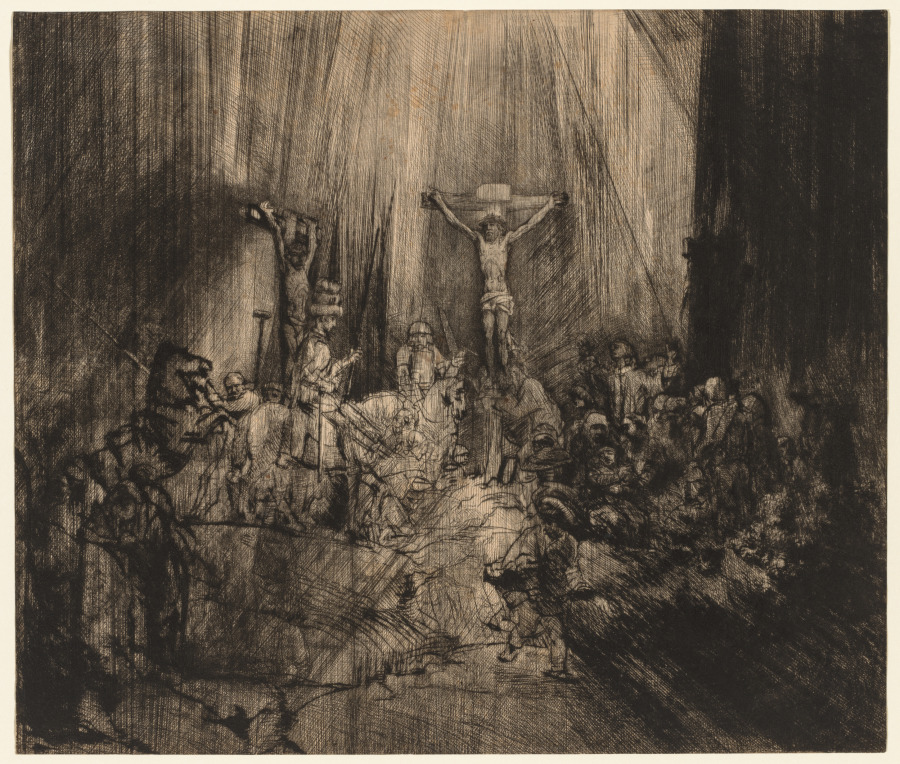
Christ Crucified Between the Two Thieves: 'The Three Crosses' (1653-c.1660) is in the Cleveland Museum of Art collection. The museum's creator attribution is Rembrandt van Rijn (Dutch, 1606–1669).
The work and its context
The museum's open-access catalogue describes the work:
Rembrandt’s Christ Crucified Between the Two Thieves is executed entirely in drypoint. Because of the delicacy of the technique, the copper plate was worn after the artist printed about 40 impressions of the first three states. In order to continue using the plate, Rembrandt reworked it, changing the image somewhat. In this fourth state, slashing strokes obscure the spectators visible in the earlier version, creating a tenebrous setting that focuses attention on Christ bathed in celestial light. Although drypoint is an inherently linear medium, Rembrandt used it to obtain tonal qualities associated with painting. The blackness becomes an active force that threatens to extinguish the light of Christ—a literal illustration of the Evangelist Luke’s description of the event that brought "a darkness over all the earth."
Object facts
- Title: Christ Crucified Between the Two Thieves: 'The Three Crosses'
- Date: 1653-c.1660
- Creator attribution: Rembrandt van Rijn (Dutch, 1606–1669)
- Culture: Rembrandt, 17th century
- Type: Print
- Technique: drypoint
- Dimensions: Sheet: 37.5 x 44 cm (14 3/4 x 17 5/16 in.)
- Collection: PR - Drypoint
- Department: Prints
- Accession number: 1959.241
A detail from the museum
When he printed this impression, Rembrandt deliberately left ink on the printing plate, specifically on the left and right sides, essentially creating a unique work.
Collection credit
Bequest of Ralph King and Purchase from the J. H. Wade Fund
Further reading listed by the museum
- S. E. L. “Year in Review.” The Bulletin of the Cleveland Museum of Art 46, no. 10 (December 1959): 210–231.
- Richards, Louise S. “Rembrandt: Chiaroscuro and the Etchings.” The Bulletin of the Cleveland Museum of Art 52, no. 4 (April 1965): 106–111.
- The Cleveland Museum of Art. Handbook of the Cleveland Museum of Art/1966. Cleveland, OH: The Cleveland Museum of Art, 1966.
View the collection record
See the museum's photographs and full catalogue entry. Catalogue text is reproduced from the Cleveland Museum of Art's open-access data, with HTML formatting removed. This object and its supplied image are designated CC0.
Sources
More in Lifestyle
Keep reading