Cinerary Urn with Amida's Pure Land (800s-900s): Art, History and Details
Cinerary Urn with Amida's Pure Land at the Cleveland Museum of Art: 800s-900s, gilt bronze. Explore the work's context, creator attribution and collection history.
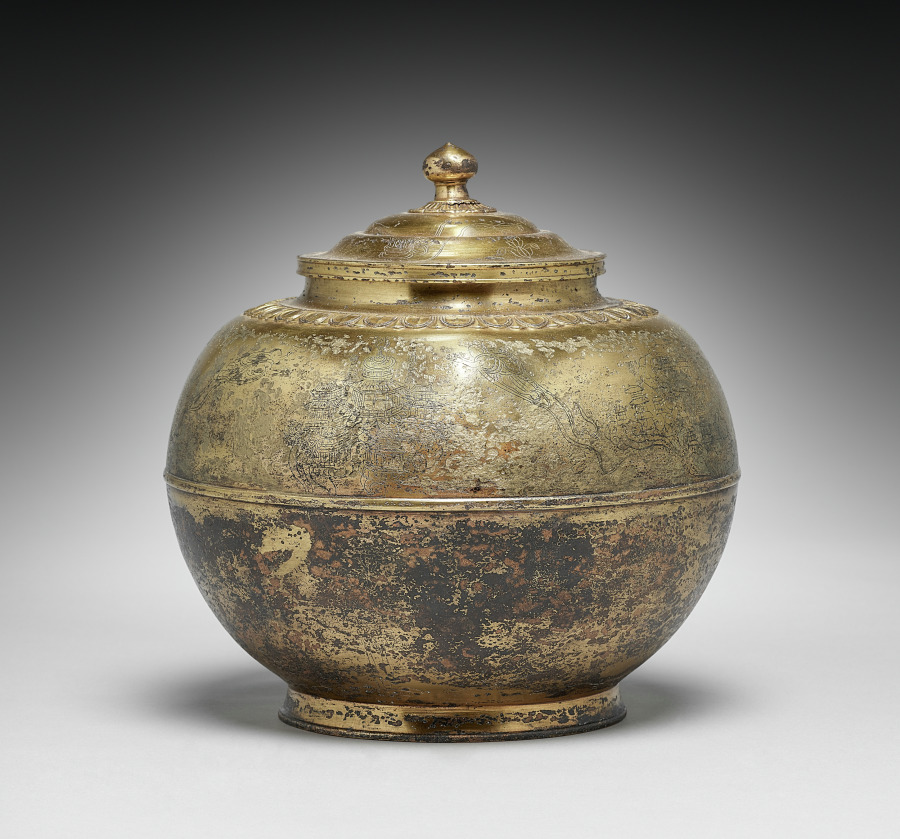
Cinerary Urn with Amida's Pure Land (800s-900s) is in the Cleveland Museum of Art collection.
The work and its context
The museum's open-access catalogue describes the work:
This urn once held someone’s ashes. It is decorated with images of the Pure Land of Amida, the Buddha of Infinite Life and Light. Heian-period devotees of Amida believed that if they called upon his name with sincerity at the moment of death, they would be born into his Pure Land, also known as the Western Paradise, and thereby escape the pattern of reincarnation. As shown on the lid of the urn, in the Pure Land, musical instruments float about playing by themselves. Its palatial structures and magnificent lotus pond are described on the body of the urn.
Object facts
- Title: Cinerary Urn with Amida's Pure Land
- Date: 800s-900s
- Culture: Japan, Heian period (794–1185)
- Type: Metalwork
- Technique: gilt bronze
- Dimensions: Diameter of mouth: 12.4 cm (4 7/8 in.); Overall: 26.1 cm (10 1/4 in.)
- Collection: Japanese Art
- Department: Japanese Art
- Accession number: 1960.55
Collection credit
Purchase from the J. H. Wade Fund
Further reading listed by the museum
- Lee, Sherman E. Japanese Decorative Style. [Cleveland]: Cleveland Museum of Art, 1961.
- Rosenfield, John M. Japanese Arts of the Heian Period, 794-1185. [New York]: Asia Society, 1967.
- Masterpieces of Japanese Art; [Catalogue of the Exhibition] October 4 Through November 30, 1969, Dallas Museum of Fine Arts. Dallas, TX: Dallas Museum of Fine Arts, 1969.
View the collection record
See the museum's photographs and full catalogue entry. Catalogue text is reproduced from the Cleveland Museum of Art's open-access data, with HTML formatting removed. This object and its supplied image are designated CC0.
Sources
More in Lifestyle
Keep reading