Cléo de Mérode (c. 1903): Art, History and Details
Cléo de Mérode at the Cleveland Museum of Art: c. 1903, color etching and aquatint. Explore the work's context, creator attribution and collection history.
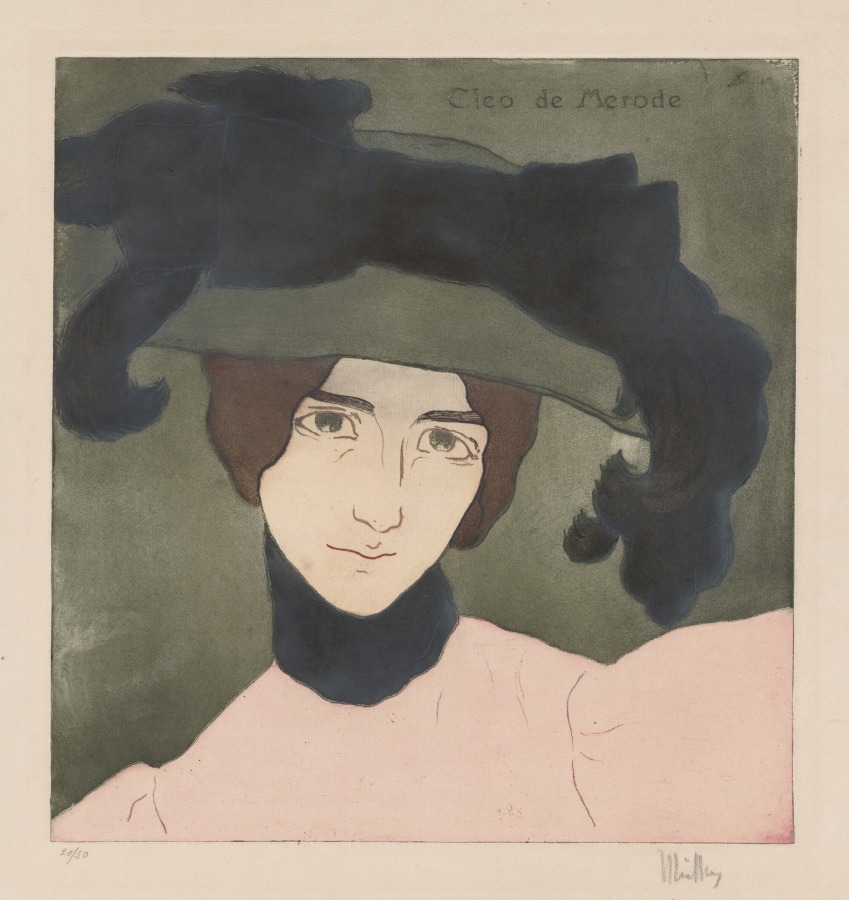
Cléo de Mérode (c. 1903) is in the Cleveland Museum of Art collection. The museum's creator attribution is Alfredo Müller (Italian, 1869–1940).
The work and its context
The museum's open-access catalogue describes the work:
Although a few printmakers experimented with printing etchings in color beginning in the 1870s, the idea did not really become popular until the 1890s. Müller represents this new interest and produced about 100 color etchings that combine densely bitten aquatint with irregularly wiped plates, epitomizing the turn-of-the-century taste for rich, painterly effects. The portrait of Cléo de Mérode (1875-1966), a fashionable dancer, is produced almost entirely in aquatint printed as broad planes and shapes of color that simplify and flatten the figure and define a shallow space. The very texture of the aquatint further emphasizes the surface and the flatness of the paper.
Object facts
- Title: Cléo de Mérode
- Date: c. 1903
- Creator attribution: Alfredo Müller (Italian, 1869–1940)
- Culture: Italy, late 19th-early 20th century
- Type: Print
- Technique: color etching and aquatint
- Dimensions: Sheet: 61 x 44 cm (24 x 17 5/16 in.); Platemark: 36.5 x 34.7 cm (14 3/8 x 13 11/16 in.)
- Collection: PR - Etching
- Department: Prints
- Accession number: 1992.36
Collection credit
Gift of Louise S. Richards
Further reading listed by the museum
- Turner, Evan H. “The Year in Review for 1992.” The Bulletin of the Cleveland Museum of Art 80, no. 2 (February 1993): 38–79.
View the collection record
See the museum's photographs and full catalogue entry. Catalogue text is reproduced from the Cleveland Museum of Art's open-access data, with HTML formatting removed. This object and its supplied image are designated CC0.
Sources
More in Lifestyle
Keep reading