Coffin of Bakenmut (c. 1000–900 BCE): Art, History and Details
Coffin of Bakenmut at the Cleveland Museum of Art: c. 1000–900 BCE, gessoed and painted sycamore fig. Explore the work's context, creator attribution and collection history.
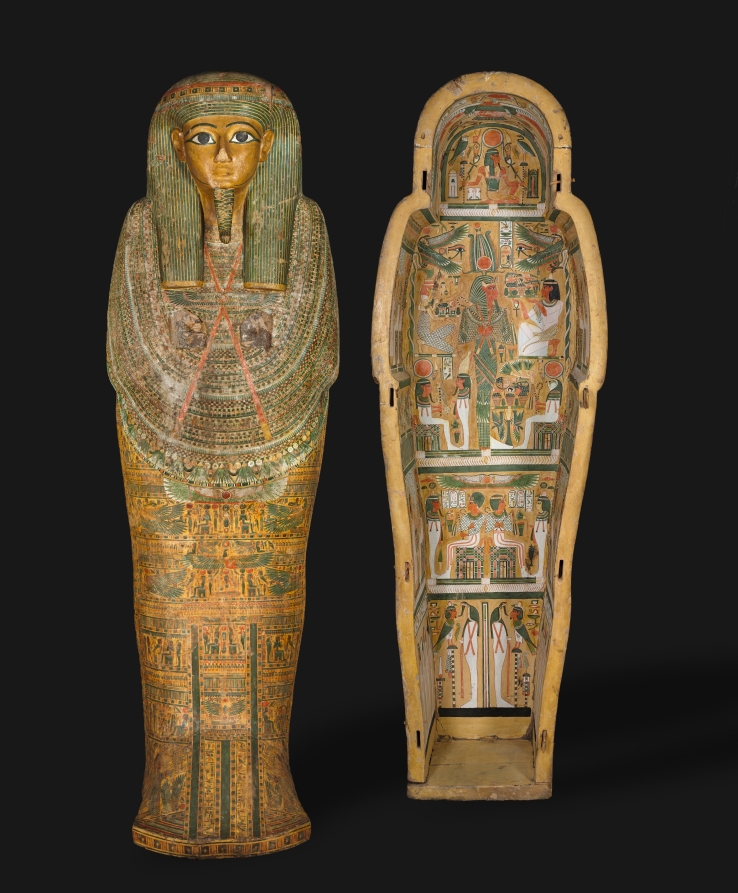
Coffin of Bakenmut (c. 1000–900 BCE) is in the Cleveland Museum of Art collection.
The work and its context
The museum's open-access catalogue describes the work:
The coffin of Bakenmut is one of the finest examples of painted wooden coffins made for the priests of Amen and their families at Thebes during Dynasty 21 and early Dynasty 22. The pharaohs of this time were no longer buried in the Valley of the Kings, but instead built tombs in the Delta, far to the north, where they resided. Security was lax in the Theban necropolis. The coffins and funerary goods of the wealthy citizens of Thebes were placed in unmarked and undecorated family tombs cut into the cliffs on the west bank of the Nile. All the care and detail that in more prosperous times were devoted to the decoration of the tomb chapel were now lavished on the elaborately painted coffins. Every available surface is crowded with religious scenes, images of funerary gods and goddesses, protective spells, and magical symbols. The deceased appears mummiform. An elaborate floral collar entirely covers the upper body, exposing only the separately attached hands (now lost). A pair of red "mummy braces" are crossed over the chest, their point of intersection marked by a winged sun disk. The lower body is covered with tiny figures modeled in gesso against a yellow background, which gives the effect of gold inlaid with glass or semiprecious stone. The decoration on the interior features two deified dead kings of Dynasty 18. Although these rulers had lived centuries before, memory of their greatness was still very much alive. The main scene near the top depicts Tuthmosis III, the great military pharaoh, who lived 500 years before Bakenmut. Posed as a mummy, the ruler wears a brilliant feathered garment enfolding him with falcon’s wings. The scene below features back-to-back seated images of Amenhotep I, regarded as the patron of the Theban cemetery and worshiped as a local god there.
Object facts
- Title: Coffin of Bakenmut
- Date: c. 1000–900 BCE
- Culture: Egypt, Thebes, Third Intermediate (1069–715 BCE), Dynasties 21–22
- Type: Funerary Equipment
- Technique: gessoed and painted sycamore fig
- Dimensions: Overall: 208 x 68 cm (81 7/8 x 26 3/4 in.)
- Collection: Egypt - Third Intermediate
- Department: Egyptian and Ancient Near Eastern Art
- Accession number: 1914.561
A detail from the museum
Originally another smaller coffin was placed inside this outer coffin and in that the deceased with a mummy board would have rested.
Collection credit
Gift of the John Huntington Art and Polytechnic Trust
Further reading listed by the museum
- Williams, Caroline Ransom. "The Egyptian Collection in the Museum of Art at Cleveland, Ohio," Journal of Egyptian Archaeology 5 (1918).
- Porter, Bertha, and Rosalind L. B. Moss. Topographical Bibliography of Ancient Egyptian Hieroglyphic Texts, Reliefs, and Paintings. Oxford: Clarendon Press, 1960.
- Cleveland Museum of Art, and Martha L. Carter. Egyptian Art, the Cleveland Museum of Art. Cleveland, Ohio: The Museum, 1963.
View the collection record
See the museum's photographs and full catalogue entry. Catalogue text is reproduced from the Cleveland Museum of Art's open-access data, with HTML formatting removed. This object and its supplied image are designated CC0.
Sources
More in Lifestyle
Keep reading


