Coffin of Nesykhonsu (lid) (c. 976–889 BCE): Art, History and Details
Coffin of Nesykhonsu (lid) at the Cleveland Museum of Art: c. 976–889 BCE, gessoed and painted sycamore fig. Explore the work's context, creator attribution and collection history.
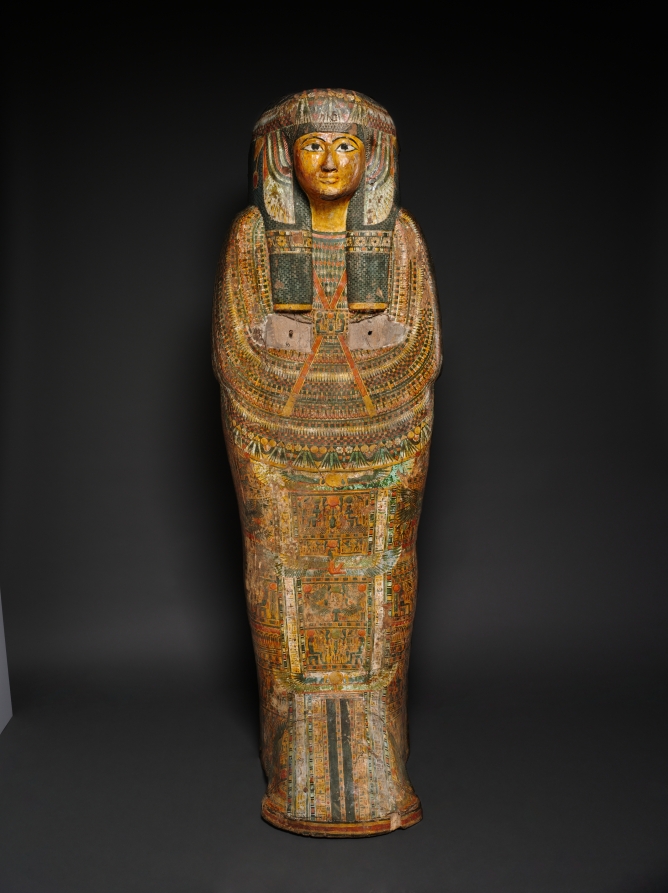
Coffin of Nesykhonsu (lid) (c. 976–889 BCE) is in the Cleveland Museum of Art collection.
The work and its context
The museum's open-access catalogue describes the work:
A complete set of coffins during the late New Kingdom and Third Intermediate Period consisted of an outer and inner coffin and a mummy board (essentially a lid without a case, placed directly over the wrapped mummy). Judging by its size, this must have been Nesykhonsu's outer coffin. The type is essentially the same as the coffin of Bakenmut, which was also an outer coffin. The two coffins are said to have been found together and to have belonged to a man and wife. This is quite possible, although the inscriptions do not bear it out. Bakenmut is not mentioned on Nesykhonsu's coffin, nor is she mentioned on his. There was by this time a tremendous repertoire of scenes appropriate for coffin decoration. Whereas Bakenmut's coffin features images of deified dead pharaohs, Nesykhonsu's is decorated in a more personal way with scenes from her own funeral. The main scene in the interior (near the top) shows a priest clad in a panther skin with the mummy of Nesykhonsu behind. The god appears in mummy form and wears a sun disk on his head. The scarab beetle inside the sun disk identifies him as Khepri, the morning sun, and the hieroglyphs to the right identify him as Atum, the evening sun. Taken together, image and text represent the sun god in both his rising and setting, youthful and aged aspects.
Object facts
- Title: Coffin of Nesykhonsu (lid)
- Date: c. 976–889 BCE
- Culture: Egypt, Third Intermediate (1069–715 BCE), Dynasties 21–22
- Type: Funerary Equipment
- Technique: gessoed and painted sycamore fig
- Dimensions: Overall: 211 cm (83 1/16 in.)
- Collection: Egypt - Third Intermediate
- Department: Egyptian and Ancient Near Eastern Art
- Accession number: 1914.714.b
A detail from the museum
Two of Nesykhonsu's titles, "Lady of the House" and "Singer of the Choir of Mut the Great," are written on the outside of the coffin.
Collection credit
Gift of the John Huntington Art and Polytechnic Trust
Further reading listed by the museum
- Kozloff, Arielle P. Egypt’s Dazzling Sun: Amenhotep III and his world. Cleveland : Cleveland Museum of Art in cooperation with Indiana University Press, 1992.
- Berman, Lawrence M., and Kenneth J. Bohač. Catalogue of Egyptian Art: The Cleveland Museum of Art. Cleveland, OH: Cleveland Museum of Art, 1999
View the collection record
See the museum's photographs and full catalogue entry. Catalogue text is reproduced from the Cleveland Museum of Art's open-access data, with HTML formatting removed. This object and its supplied image are designated CC0.
Sources
More in Lifestyle
Keep reading
Related stories


