Coin of Eukratides I (170–145 BCE): Art, History and Details
Coin of Eukratides I at the Cleveland Museum of Art: 170–145 BCE, silver. Explore the work's context, creator attribution and collection history.
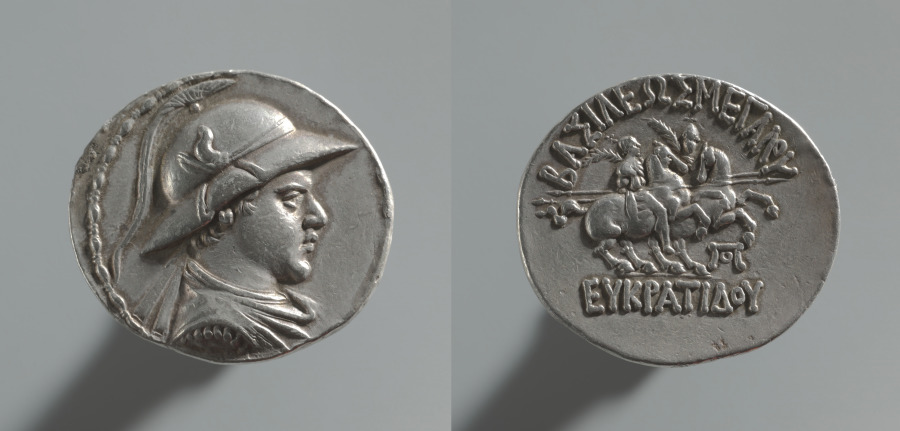
Coin of Eukratides I (170–145 BCE) is in the Cleveland Museum of Art collection.
The work and its context
The museum's open-access catalogue describes the work:
After Alexander of Macedon succeeded in conquering Egypt and Persia in 331 BC, his ambition to rule the known world led him further east across Bactria in Afghanistan, through the Hindu Kush mountain pass, and into India. There he succeeded in defeating all the local kings of the region until his men, on the brink of mutiny, insisted that they return to Greece. Alexander left governors in charge of his territories, and after his death in 323 BC, his governors became independent kings, establishing Hellenistic cities and a Greek cultural base in the region, which lasted for almost 200 years. The king of Greek descent who ruled over territories in Afghanistan and Pakistan depicted himself with the brimmed military helmet with the bull's ear and horn of Poseidon, worn by generals from Macedon, the northern Greek country from which Alexander came. After his death, Alexander's vast empire that stretched from Macedon across Egypt and Persia all the way to the Indus River was divided among military leaders in his army. On the reverse side of this coin are the twins Castor and Pollux riding horseback with long spears. These twins were sons of Zeus. Since Alexander considered himself to be an offspring of Zeus, Eukratides referenced his link to Alexander by including them on his coin.
Object facts
- Title: Coin of Eukratides I
- Date: 170–145 BCE
- Culture: Afghanistan, Bactria, Eucratides I (171–145 BCE)
- Type: Coins
- Technique: silver
- Dimensions: Diameter: 3.4 cm (1 5/16 in.)
- Collection: Indian Art - Kushan, Gandhara
- Department: Indian and Southeast Asian Art
- Accession number: 1999.319
Collection credit
John L. Severance Fund
View the collection record
See the museum's photographs and full catalogue entry. Catalogue text is reproduced from the Cleveland Museum of Art's open-access data, with HTML formatting removed. This object and its supplied image are designated CC0.
Sources
More in Lifestyle
Keep reading