Colossal Head of a Deva (c. 1200): Art, History and Details
Colossal Head of a Deva at the Cleveland Museum of Art: c. 1200, sandstone. Explore the work's context, creator attribution and collection history.
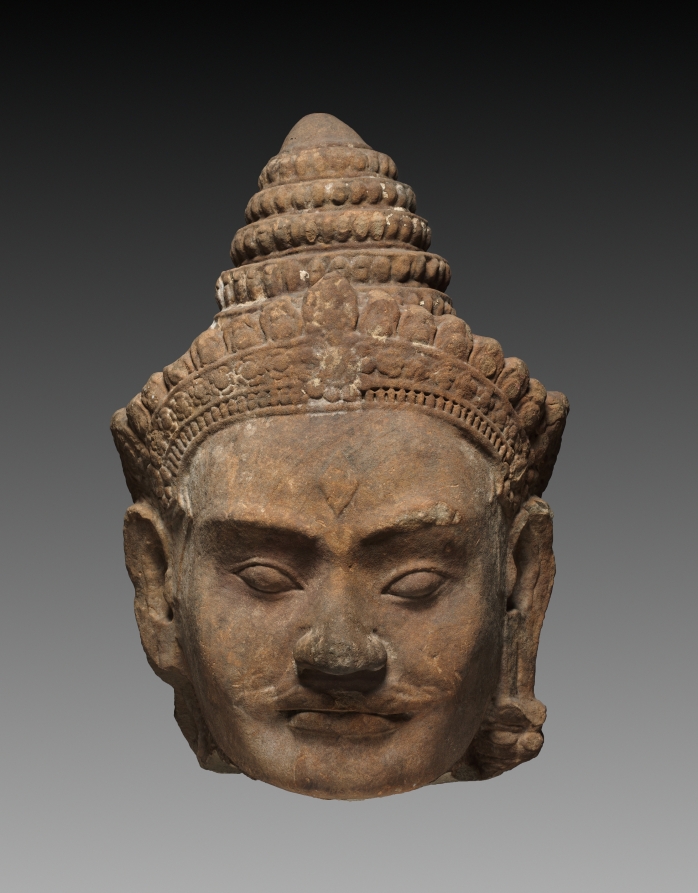
Colossal Head of a Deva (c. 1200) is in the Cleveland Museum of Art collection.
The work and its context
The museum's open-access catalogue describes the work:
This head is from one of the gods (devas in Sanskrit) who, according to Hindu myth, churned the primordial Ocean of Milk to extract the nectar of immortality. Using a mountain as a churning rod and a serpent as the rope, the gods on one side and the demons on the other vied to win the nectar. The gods prevailed and achieved immortality.
Object facts
- Title: Colossal Head of a Deva
- Date: c. 1200
- Culture: Cambodia, Angkor, Preah Khan
- Type: Stone
- Technique: sandstone
- Dimensions: Overall: 71.3 x 50 x 47 cm (28 1/16 x 19 11/16 x 18 1/2 in.)
- Collection: Cambodian Art
- Department: Indian and Southeast Asian Art
- Accession number: 2011.147
A detail from the museum
The deity’s conical tiara consists of a diadem with floral decoration and is topped by a five-tiered lotus narrowing upward.
Collection credit
Gift of Maxeen and John Flower in honor of Dr. Stanislaw Czuma
Further reading listed by the museum
- Sotheby's, New York. Indian & Southeast Asian Art. 26 March 2003. Lot 28.
- Mann, C. Griffith, and Amy Bracken Sparks. "Acquisitions 2011." Cleveland Art: Cleveland Museum of Art Members Magazine 52, no. 2 (March/April 2012): 10–27.
View the collection record
See the museum's photographs and full catalogue entry. Catalogue text is reproduced from the Cleveland Museum of Art's open-access data, with HTML formatting removed. This object and its supplied image are designated CC0.
Sources
More in Lifestyle
Keep reading