Columbine and Harlequin (c. 1729): Art, History and Details
Columbine and Harlequin at the Cleveland Museum of Art: c. 1729, etching. Explore the work's context, creator attribution and collection history.
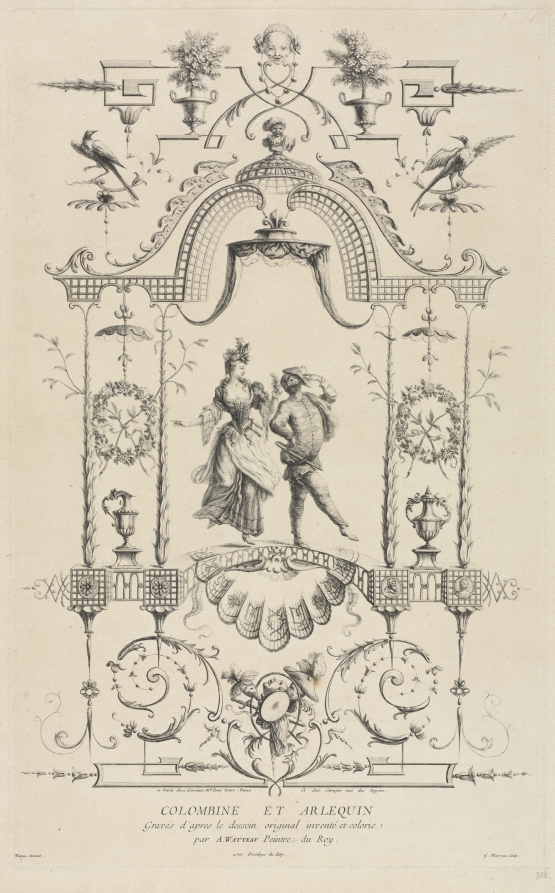
Columbine and Harlequin (c. 1729) is in the Cleveland Museum of Art collection. The museum's creator attribution is Jean Moyreau (French, 1690–1762); Jean-Antoine Watteau (French, 1684–1721).
The work and its context
The museum's open-access catalogue describes the work:
Arabesques (decorations with curves and tendrils inspired by plant forms) were in vogue in 18th-century France. Watteau (1684-1721) produced arabesques for the ornamentation of walls, paneling, furniture, and ceilings. He depicted popular motifs, such as the elegant courtship in an idyllic outdoor setting pictured in The Gallant, shown nearby, or as in Columbine and Harlequin, two characters from productions of the Commedia dell'arte, an Italian comic theater. Watteau launched a trend for the exotic scenes found on imported Chinese porcelains and lacquer ware about 1707. The parasol in The Gallant, and the Asian face that smiles down from the top of Columbine and Harlequin, are examples of chinoiserie, the playful imitation of Chinese art.
Object facts
- Title: Columbine and Harlequin
- Date: c. 1729
- Creator attribution: Jean Moyreau (French, 1690–1762); Jean-Antoine Watteau (French, 1684–1721)
- Culture: France
- Type: Print
- Technique: etching
- Dimensions: Platemark: 51.6 x 32 cm (20 5/16 x 12 5/8 in.)
- Collection: PR - Etching
- Department: Prints
- Accession number: 1927.327
Collection credit
Gift of The Print Club of Cleveland
View the collection record
See the museum's photographs and full catalogue entry. Catalogue text is reproduced from the Cleveland Museum of Art's open-access data, with HTML formatting removed. This object and its supplied image are designated CC0.
Sources
More in Lifestyle
Keep reading