Comma-shaped Jade (400s CE): Art, History and Details
Comma-shaped Jade at the Cleveland Museum of Art: 400s CE, glass. Explore the work's context, creator attribution and collection history.
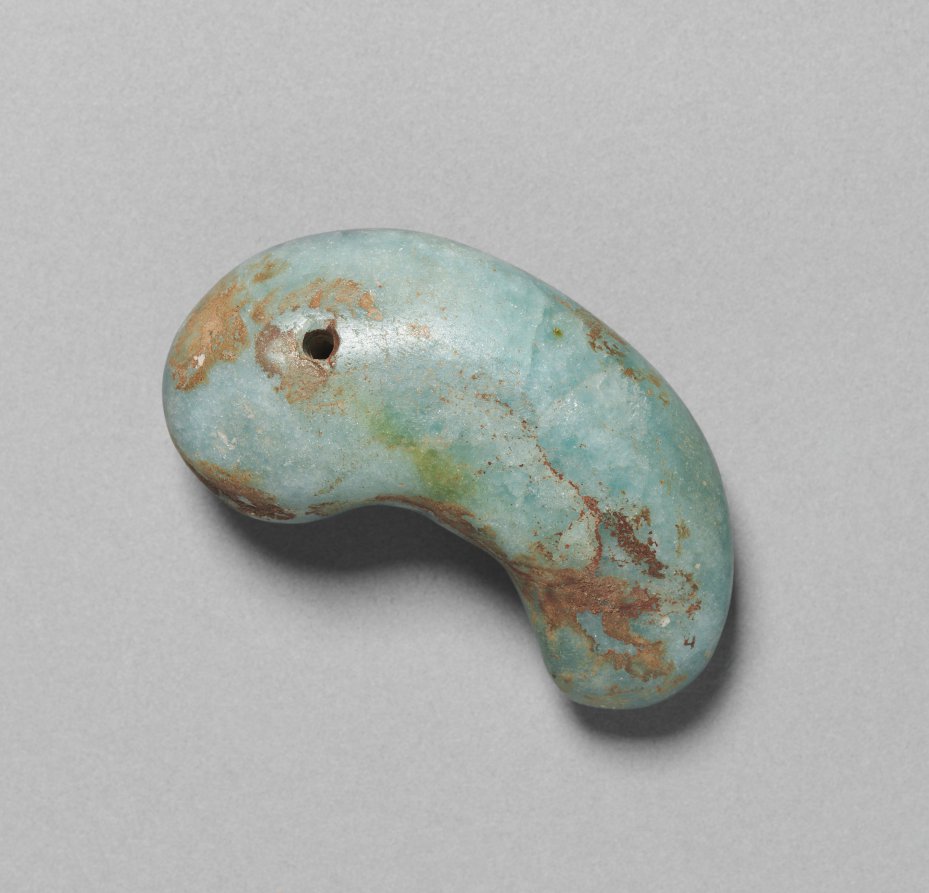
Comma-shaped Jade (400s CE) is in the Cleveland Museum of Art collection.
The work and its context
The museum's open-access catalogue describes the work:
Jade is one of the hardest stones and requires an intensive, arduous process of abrasion—cutting, chiseling, grinding, and polishing—to achieve the desired shape. A grindstone and a slurry of grit and water shape the jade into the desired form, and then a cloth dampened and rubbed with finer grit may have been used to give the jade the smooth surface. For the Silla kingdom (57 BC–985), in particular, comma-shaped jades served as an essential item for the burials of the ruling class and were luxurious accessories to decorate golden crowns. Their comma shape is thought to represent embryonic forms, symbolizing life, particularly rebirth in the afterlife.
Object facts
- Title: Comma-shaped Jade
- Date: 400s CE
- Culture: Korea, Three Kingdoms period (57 BCE–668 CE)
- Type: Jewelry
- Technique: glass
- Dimensions: Overall: 7.3 x 3.9 x 2.5 cm (2 7/8 x 1 9/16 x 1 in.)
- Collection: Korean Art
- Department: Korean Art
- Accession number: 1917.1056
A detail from the museum
This unique shaped jade was used as a pendant to decorate necklaces, earrings, and crowns during the Three Kingdoms period.
Collection credit
Gift of the John Huntington Art and Polytechnic Trust
Further reading listed by the museum
- Golden Splendors: the Royal Tomb of Silla Hwangnamdaechong [황남대총: 황금의나라신라의왕릉]. Seoul: National Museum of Korea, 2010.
- Kim, Yang-dong. “ A cultural examination of the origin and symbol of comma-shaped jades of ancient Korea [고대한국곡옥의기원과상징에대한문화사적검토].” Silla sahakbo 25 (2012): 401-436.
- Lee, So-young, and Denise Patry Leidy. Silla: Korea's Golden Kingdom. New York: The Metropolitan Museum of Art, 2013.
View the collection record
See the museum's photographs and full catalogue entry. Catalogue text is reproduced from the Cleveland Museum of Art's open-access data, with HTML formatting removed. This object and its supplied image are designated CC0.
Sources
More in Lifestyle
Keep reading