Courtesan (1700s): Art, History and Details
Courtesan at the Cleveland Museum of Art: 1700s, hanging scroll; ink and color paper. Explore the work's context, creator attribution and collection history.
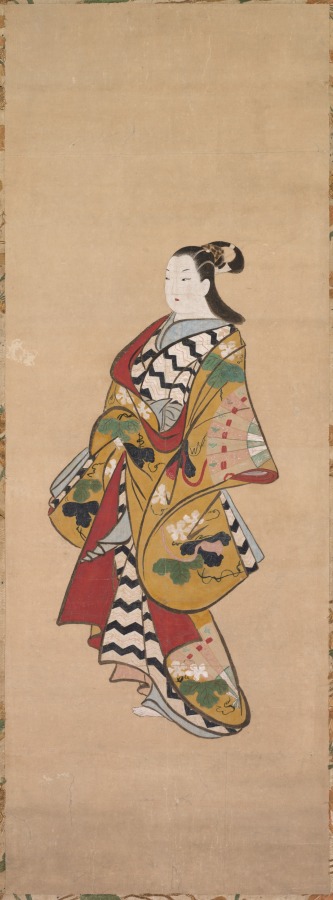
Courtesan (1700s) is in the Cleveland Museum of Art collection. The museum's creator attribution is Kaigetsudō Ando (Japanese, c. 1671–1743).
The work and its context
The museum's open-access catalogue describes the work:
Paintings of the courtesans who provided men with a sophisticated menu of appealing fashions, flattery, witty banter, music, dancing, and sexual services in the Yoshiwara district of the city of Edo (Tokyo) were the bread and butter of the Kaigetsudō studio, in whose style this work is painted. Their paintings emphasized bold, sweeping calligraphic ink lines in rendering the figures’ forms, along with high-contrast colors and patterns in their typically solitary subjects’ garments. Aside from the occasional prop or poem, the space around the dramatic figure was left entirely blank.
Object facts
- Title: Courtesan
- Date: 1700s
- Creator attribution: Kaigetsudō Ando (Japanese, c. 1671–1743)
- Culture: Japan, Edo period (1615–1868)
- Type: Painting
- Technique: hanging scroll; ink and color paper
- Dimensions: Overall: 182.9 x 53.4 cm (72 x 21 in.); Overall: 181.6 x 47.8 cm (71 1/2 x 18 13/16 in.); Painting only: 95.7 x 35.5 cm (37 11/16 x 14 in.); Painting only: 97.4 x 35.5 cm (38 3/8 x 14 in.)
- Collection: ASIAN - Hanging scroll
- Department: Japanese Art
- Accession number: 1985.264
Collection credit
The Kelvin Smith Collection, given by Mrs. Kelvin Smith
Further reading listed by the museum
- “Checklist of the Kelvin Smith Bequest.” The Bulletin of the Cleveland Museum of Art 75, no. 7 (September 1988): 292–295.
View the collection record
See the museum's photographs and full catalogue entry. Catalogue text is reproduced from the Cleveland Museum of Art's open-access data, with HTML formatting removed. This object and its supplied image are designated CC0.
Sources
More in Lifestyle
Keep reading