Courtesan and Sleeping Attendant (late 1760s): Art, History and Details
Courtesan and Sleeping Attendant at the Cleveland Museum of Art: late 1760s, color woodblock print, with embossing. Explore the work's context, creator attribution and collection history.
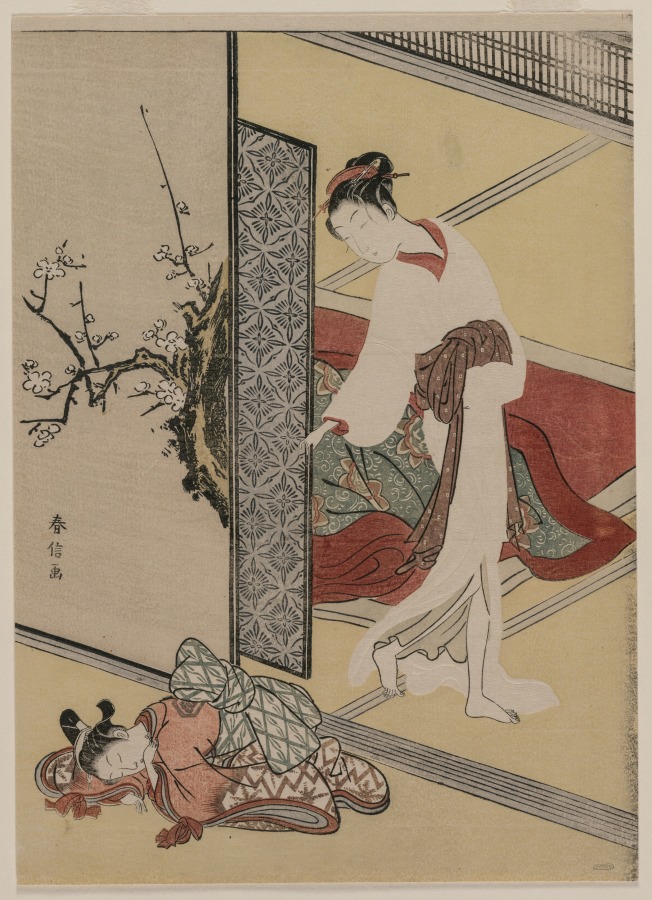
Courtesan and Sleeping Attendant (late 1760s) is in the Cleveland Museum of Art collection. The museum's creator attribution is Suzuki Harunobu (Japanese, 1724–1770).
The work and its context
The museum's open-access catalogue describes the work:
In this print, a courtesan emerges from her bed to find her attendant asleep. As was customary, the courtesan has her obi sash tied at the front, while her servant has hers tied at the back. The strong contrast between the colorful bedclothes and the white of the courtesan’s robe is heightened by the embossing of the fabric folds, lending a three-dimensional effect to her form. The technique involves pressing a carved but unpigmented woodblock against the print surface.
Object facts
- Title: Courtesan and Sleeping Attendant
- Date: late 1760s
- Creator attribution: Suzuki Harunobu (Japanese, 1724–1770)
- Culture: Japan, Edo period (1615–1868)
- Type: Print
- Technique: color woodblock print, with embossing
- Dimensions: Overall: 28.1 x 20.1 cm (11 1/16 x 7 15/16 in.)
- Collection: Japanese Art
- Department: Japanese Art
- Accession number: 1985.309
Collection credit
The Kelvin Smith Collection, given by Mrs. Kelvin Smith
Further reading listed by the museum
- Sotheby's London. Highly Important Japanese Prints, Illustrated Books and Drawings and Paintings, from the Henri Vever Collection: Part III. March 24, 1977.
- “Checklist of the Kelvin Smith Bequest.” The Bulletin of the Cleveland Museum of Art 75, no. 7 (September 1988): 292–295.
View the collection record
See the museum's photographs and full catalogue entry. Catalogue text is reproduced from the Cleveland Museum of Art's open-access data, with HTML formatting removed. This object and its supplied image are designated CC0.
Sources
More in Lifestyle
Keep reading