Cranes and Serpents (475–221 BCE): Art, History and Details
Cranes and Serpents at the Cleveland Museum of Art: 475–221 BCE, lacquered wood with polychromy. Explore the work's context, creator attribution and collection history.
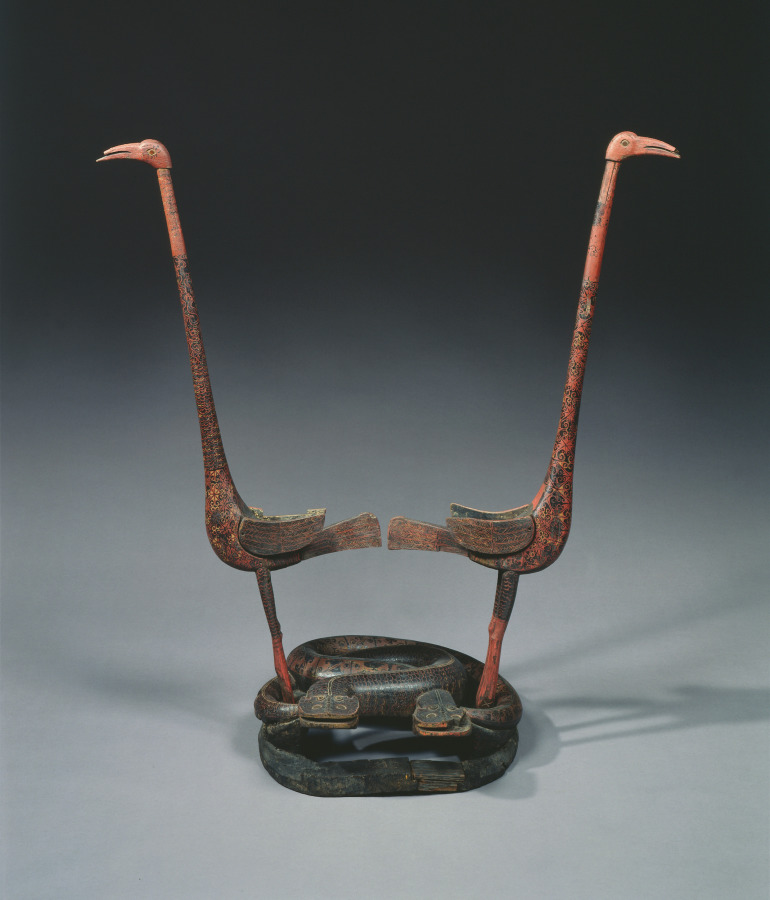
Cranes and Serpents (475–221 BCE) is in the Cleveland Museum of Art collection.
The work and its context
The museum's open-access catalogue describes the work:
A different style of ritual art developed in the state of Chu in South China. In addition to bronze vessels, lacquered wood artifacts expanded the repertory of ritual implements. This extraordinary sculpture was probably a drum stand for supporting a suspended drum in ritual ceremonies. It is unique among other excavated drum stands of the Chu, which typically show two birds standing on tigers. The theme of the bird stepping on the serpent was common in the Chu visual culture. Yet the slender proportions and seemingly flimsy structure of this particular set raise the question of whether it was utilitarian or mostly served symbolic functions in the tomb. The birds' and serpents' bodies have designs painted in red lacquer and yellow pigment against the black lacquer. Scientific analyses confirm the additional use of a blue or green pigment that has been discolored over time.
Object facts
- Title: Cranes and Serpents
- Date: 475–221 BCE
- Culture: China, reportedly from Hunan province, Changsha, Warring States period (475–221 BCE), State of Chu (c. 1046–223 BCE)
- Type: Sculpture
- Technique: lacquered wood with polychromy
- Dimensions: Overall: 132.1 x 124.5 cm (52 x 49 in.)
- Collection: China - Zhou Dynasty
- Department: Chinese Art
- Accession number: 1938.9
A detail from the museum
The cranes' long necks allowed a lightweight drum to be suspended from strings through the beaks, while the densely intertwined snakes provided a weighty base to stabilize the object during musical performances.
Collection credit
Purchase from the J. H. Wade Fund
Further reading listed by the museum
- Umehara Sueji 梅原末治 and Mizuno Seiichi 水野清一. "Wooden Cranes and Snakes, decorated with Lacquer, said to have been discovered in Chang-sha, China" [傳長沙出土の漆畫雙鶴雙蛇に就いて]. Bijutsu Kenkyū [美術硏究 = Journal of the Japanese Art History Society] no. 72 (December 1937), pp. 487-491.
- “Accessions.” The Bulletin of the Cleveland Museum of Art, vol. 25, no. 2, 1938, pp. 29–32.
- Hollis, Howard C. “Cranes and Serpents.” The Bulletin of the Cleveland Museum of Art, vol. 25, no. 8, 1938, pp. 147–151, 159.
View the collection record
See the museum's photographs and full catalogue entry. Catalogue text is reproduced from the Cleveland Museum of Art's open-access data, with HTML formatting removed. This object and its supplied image are designated CC0.
Sources
More in Lifestyle
Keep reading

![Initial S[alve sancta parens] from a Gradual: Madonna and Child (c. 1370–74; Cleveland 1924.1012)](https://openaccess-cdn.clevelandart.org/1924.1012/1924.1012_web.jpg)