Crocodile Pendant (1000–1550): Art, History and Details
Crocodile Pendant at the Cleveland Museum of Art: 1000–1550, cast gold, modern greenstone. Explore the work's context, creator attribution and collection history.
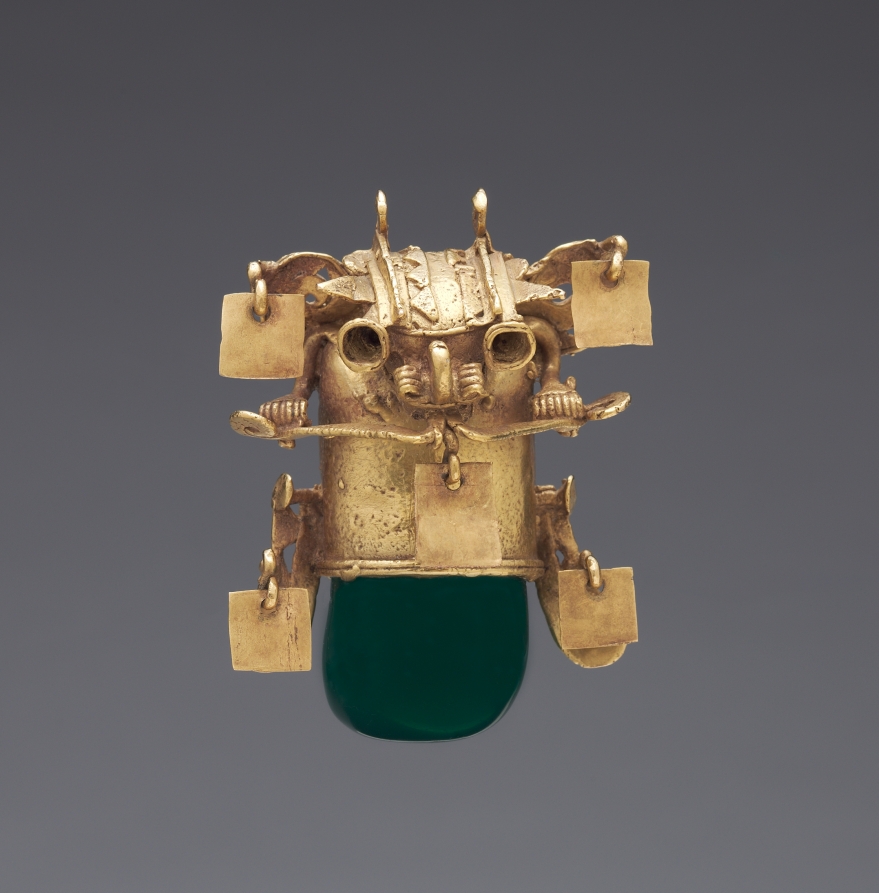
Crocodile Pendant (1000–1550) is in the Cleveland Museum of Art collection.
The work and its context
The museum's open-access catalogue describes the work:
Of great importance in ancient Panama were beings that combined crocodile features, especially the mouth, with lizard traits, such as the iguana’s head crest. This example also has a back-swept nose, perhaps that of the leaf-nosed bat. The greenstone is a modern replacement for a stone or shell that once completed the crocodile’s body.
Object facts
- Title: Crocodile Pendant
- Date: 1000–1550
- Culture: Panama, Azuero Peninsula, Parita style, 11th-16th century
- Type: Metalwork
- Technique: cast gold, modern greenstone
- Dimensions: Overall: 6.5 x 5.5 x 4.4 cm (2 9/16 x 2 3/16 x 1 3/4 in.)
- Collection: AA - Intermediate Region
- Department: Art of the Americas
- Accession number: 1990.160
A detail from the museum
The greenstone replaced a piece of carved whale bone that was once improperly paired with the pendant.
Collection credit
Gift of Mr. and Mrs. James C. Gruener
Further reading listed by the museum
- Von Winning, Hasso, and Alfred Stendahl. Pre-Columbian Art of Mexico and Central America: Text and Notes by Hasso Von Winning. Selection of Plates by Alfred Stendahl. New York: H.N. Abrams, 1968.
- Young-Sánchez, Margaret. "The Gruener Collection of Pre-Columbian Art." The Bulletin of the Cleveland Museum of Art 79, no. 7 (1992): 234-75.
View the collection record
See the museum's photographs and full catalogue entry. Catalogue text is reproduced from the Cleveland Museum of Art's open-access data, with HTML formatting removed. This object and its supplied image are designated CC0.
Sources
More in Lifestyle
Keep reading