Crucified Christ (c. 1340–1350): Art, History and Details
Crucified Christ at the Cleveland Museum of Art: c. 1340–1350, wood (walnut) once polychromed. Explore the work's context, creator attribution and collection history.
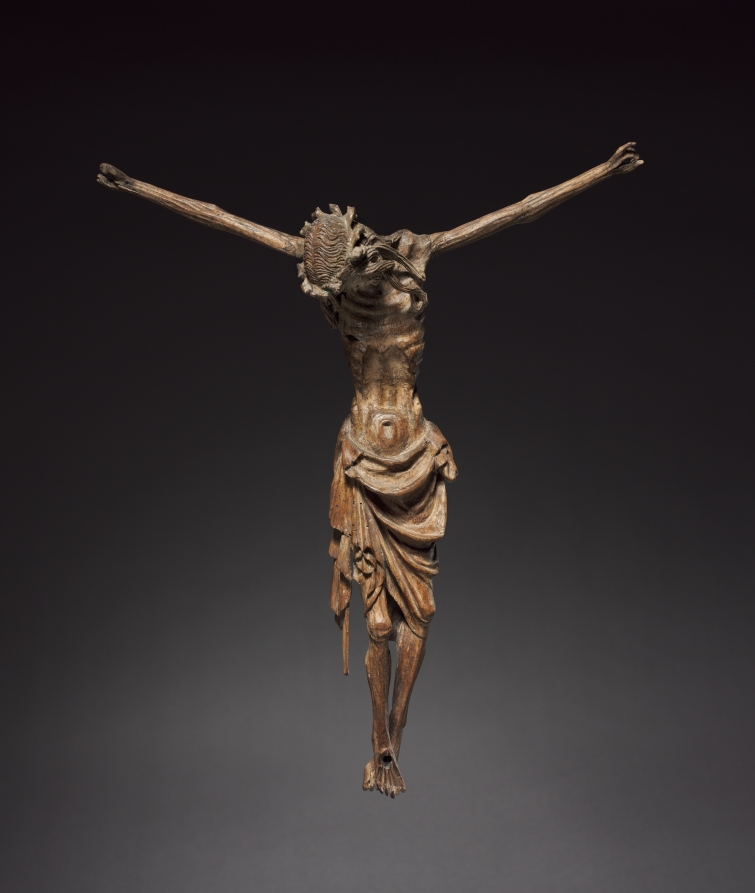
Crucified Christ (c. 1340–1350) is in the Cleveland Museum of Art collection.
The work and its context
The museum's open-access catalogue describes the work:
The striking impression of this figure is the vivid representation of suffering. The sculpture captures the moment after Christ’s death: the drooping head on a frail neck is a mask of agony. The eyes are nearly shut, the mouth is ajar, and the forehead crowned by heavy, gouging thorns is drawn with pain. The elongation of the body is emphasized by the emaciated chest with protruding ribs and bony limbs. The resulting sense of frailty and pathos is augmented by the heavy strands of hair that uncurl alongside the tormented face and by the loincloth folds that break the downward drape of the body. The sculpture belongs to a group of emotional crucifixes and pietas carved in the Middle-Rhine region for over a century beginning around 1300, examples of which are principally found in the city of Cologne. Such sculptures appealed to the Rhenish mystics, who advocated meditation based on the Passion of Christ.
Object facts
- Title: Crucified Christ
- Date: c. 1340–1350
- Culture: Germany, Cologne
- Type: Sculpture
- Technique: wood (walnut) once polychromed
- Dimensions: Overall: 41.6 x 36.9 cm (16 3/8 x 14 1/2 in.)
- Collection: MED - Gothic
- Department: Medieval Art
- Accession number: 1981.52
Collection credit
Andrew R. and Martha Holden Jennings Fund
Further reading listed by the museum
- Lee, Sherman E. “The Year in Review for 1981.” The Bulletin of the Cleveland Museum of Art 69, no. 2 (February 1982): 39–82.
- De Winter, Patrick M. “A Middle-Rhenish ‘Crucifixus Dolorosus’ of the Late Fourteenth Century.” The Bulletin of the Cleveland Museum of Art 69, no. 7 (September 1982): 224–235.
- Lutz, Gerhard. "Bildewerke des Gekreuzigten Christus zwischen 1350 und 1450 - Versuch einer Neubewertung." In Zeitenwende 1400: Hildesheim als europäische Metropole, 67 -82. Claudia Höhl, Gerhard Lutz and Felix Prinz. Regensburg : Schnell & Steiner GmbH, 2019.
View the collection record
See the museum's photographs and full catalogue entry. Catalogue text is reproduced from the Cleveland Museum of Art's open-access data, with HTML formatting removed. This object and its supplied image are designated CC0.
Sources
More in Lifestyle
Keep reading
Related stories