Crucifixion with the Two Thieves (1450–1500): Art, History and Details
Crucifixion with the Two Thieves at the Cleveland Museum of Art: 1450–1500, pen and brown ink and black chalk. Explore the work's context, creator attribution and collection history.
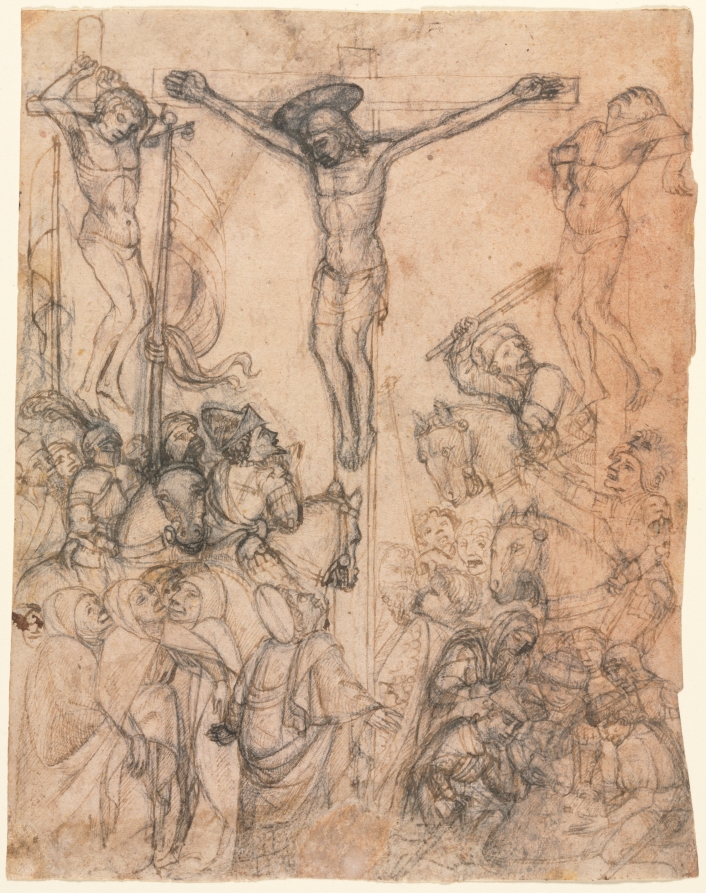
Crucifixion with the Two Thieves (1450–1500) is in the Cleveland Museum of Art collection.
The work and its context
The museum's open-access catalogue describes the work:
To make this drawing—which could be a ricordi (a visual record of a painting)—the artist first sketched part of the composition with charcoal before completing it with pen and ink. Charcoal was not regularly used as a drawing medium until the second half of the 1400s. Even then, it was usually a secondary medium, as seen here, meant to sketch or outline figures to be completed in other media. Charcoal and black chalk became more popular with later generations of artists, including Michelangelo, who found the supple qualities of the media ideal for rendering the human figure.
Object facts
- Title: Crucifixion with the Two Thieves
- Date: 1450–1500
- Culture: Italy, Piedmont
- Type: Drawing
- Technique: pen and brown ink and black chalk
- Dimensions: Sheet: 24.4 x 19.4 cm (9 5/8 x 7 5/8 in.)
- Collection: DR - Italian
- Department: Drawings
- Accession number: 1956.43
A detail from the museum
In the left foreground Christ's grieving mother, Mary, is supported by two other women: Mary Magdalene and Mary of Clopas. This common grouping is often called the Three Marys.
Collection credit
Delia E. and L. E. Holden Funds and John L. Severance Fund
Further reading listed by the museum
- Francis, Henry S. “Rare Italian Drawings” The Bulletin of the Cleveland Museum of Art 45, no. 8 (1958): 195–202.
- Ragghianti, Carlo L., ed. “Acquisti di Musei.” Sele arte, no. 40 (March 1959).
- Verdier, Phillippe, ed. The International Style: The Arts in Europe Around 1400. Walters Art Gallery, 1962.
View the collection record
See the museum's photographs and full catalogue entry. Catalogue text is reproduced from the Cleveland Museum of Art's open-access data, with HTML formatting removed. This object and its supplied image are designated CC0.
Sources
More in Lifestyle
Keep reading