Dagger (Khanjali) with Scabbard (1700s–1800s): Art, History and Details
Dagger (Khanjali) with Scabbard at the Cleveland Museum of Art: 1700s–1800s, carnelian?, steel, wood handle, copper alloy, and silver gilt. Explore the work's context, creator attribution and collection history.
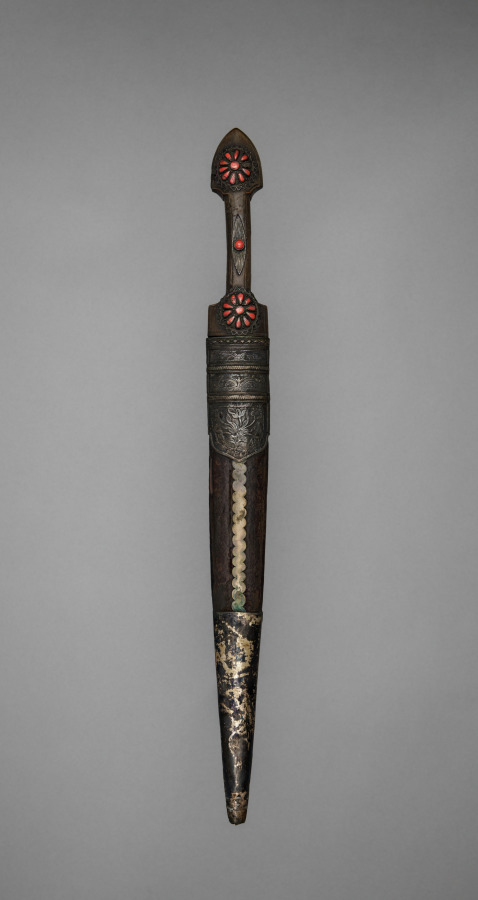
Dagger (Khanjali) with Scabbard (1700s–1800s) is in the Cleveland Museum of Art collection.
The work and its context
The museum's open-access catalogue describes the work:
A khanjali is a dagger popular with the inhabitants of Georgia and the rest of the Caucasus since ancient times. They often have a single offset groove on each face of the blade and the shape is similar to the ancient Roman gladius and the Scottish dirk.
Object facts
- Title: Dagger (Khanjali) with Scabbard
- Date: 1700s–1800s
- Culture: Transcaucasian, Georgian
- Type: Arms and Armor
- Technique: carnelian?, steel, wood handle, copper alloy, and silver gilt
- Dimensions: Overall: 52.1 cm (20 1/2 in.); Blade: 35.9 cm (14 1/8 in.)
- Collection: MED - Arms & Armor
- Department: Medieval Art
- Accession number: 1916.736
A detail from the museum
Scabbards for daggers like these are usually highly engraved with gold or silver designs and can sometimes include embedded gemstones.
Collection credit
Gift of J. H. Wade
View the collection record
See the museum's photographs and full catalogue entry. Catalogue text is reproduced from the Cleveland Museum of Art's open-access data, with HTML formatting removed. This object and its supplied image are designated CC0.
Sources
More in Lifestyle
Keep reading


