Dagger (red velvet case) (1700s–1800s): Art, History and Details
Dagger (red velvet case) at the Cleveland Museum of Art: 1700s–1800s, Wood sheath covered in velvet with metallic thread. Explore the work's context, creator attribution and collection history.
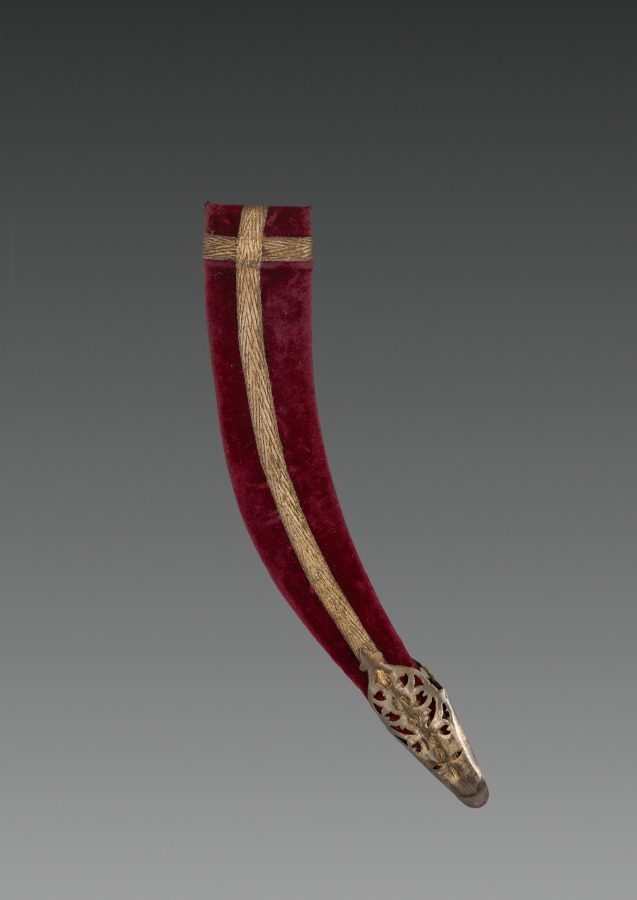
Dagger (red velvet case) (1700s–1800s) is in the Cleveland Museum of Art collection.
The work and its context
The museum's open-access catalogue describes the work:
Daggers with curved blades, known as khanjar, were worn tucked into the belt as one of the basic accessories for Mughal men. An all-purpose knife that could be used in hunting or fighting, the khanjar was also a visible status symbol. The use of jade and gold indicates that this dagger was owned by a member of the court. The gold inscriptions on the blade, just under the hilt, are quotations from the Qur’an, the most sacred book for Muslims. On one side is the opening line: “In the Name of God the Merciful and the Compassionate,” and on the other is a popular verse from chapter (sura) 61: “Help comes from God, and Victory is imminent.”
Object facts
- Title: Dagger (red velvet case)
- Date: 1700s–1800s
- Culture: India
- Type: Arms and Armor
- Technique: Wood sheath covered in velvet with metallic thread
- Dimensions: Overall: 34.4 cm (13 9/16 in.)
- Collection: Indian Art
- Department: Indian and Southeast Asian Art
- Accession number: 1930.708.b
Collection credit
Gift of S. D. Wright
Further reading listed by the museum
- “Part II. Fifteenth Annual Report of the Cleveland Museum of Art 1930.” The Bulletin of the Cleveland Museum of Art, vol. 18, no. 2, 1931, pp. 1–128.
View the collection record
See the museum's photographs and full catalogue entry. Catalogue text is reproduced from the Cleveland Museum of Art's open-access data, with HTML formatting removed. This object and its supplied image are designated CC0.
Sources
More in Lifestyle
Keep reading