Dancers and Musicians from Phrygia (1–100 CE): Art, History and Details
Dancers and Musicians from Phrygia at the Cleveland Museum of Art: 1–100 CE, schist. Explore the work's context, creator attribution and collection history.
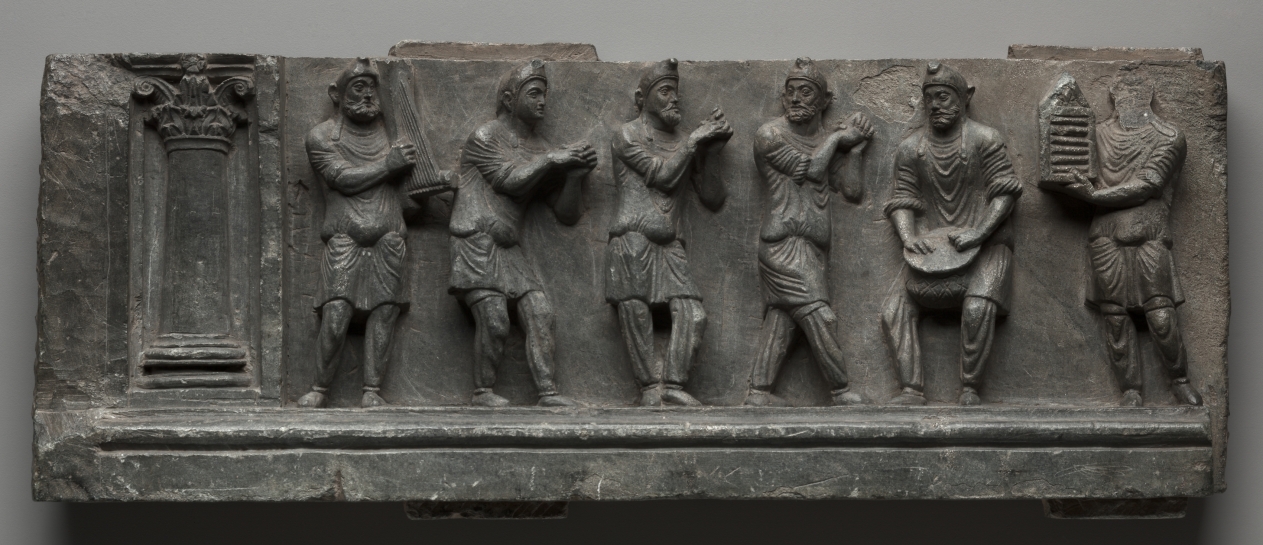
Dancers and Musicians from Phrygia (1–100 CE) is in the Cleveland Museum of Art collection.
The work and its context
The museum's open-access catalogue describes the work:
The distinctive garments worn by the figures on this relief may identify them as people from the ancient region of Phrygia, in present-day central Turkey. They wear baggy tunics with trousers tied at the ankles and peaked caps. Three figures hold their feet and hands in postures of dancing, while a musician plays a stringed instrument similar to a lyre, and a percussionist keeps time on the drum clutched between his legs. The figure at the far right holds up an unidentified object. This panel has tenons above and below to fit into a structure using no mortar. The scale of this panel suggests that it was installed as a stair riser.
Object facts
- Title: Dancers and Musicians from Phrygia
- Date: 1–100 CE
- Culture: Pakistan, Gandhara, Buner area, early Kushan period
- Type: Sculpture
- Technique: schist
- Dimensions: Overall: 17.1 x 44.5 cm (6 3/4 x 17 1/2 in.)
- Collection: Indian Art - Kushan, Gandhara
- Department: Indian and Southeast Asian Art
- Accession number: 1930.328.1
A detail from the museum
The peaked hats they wear are called "Phrygian caps."
Collection credit
Dudley P. Allen Fund
Further reading listed by the museum
- Hollis, Howard. C. “Indian Sculpture.” The Bulletin of the Cleveland Museum of Art, vol. 17, no. 10, 1930, pp. 190–198.
- Stites, Raymond S. The Arts and Man. New York: Whittlesey House, 1940.
View the collection record
See the museum's photographs and full catalogue entry. Catalogue text is reproduced from the Cleveland Museum of Art's open-access data, with HTML formatting removed. This object and its supplied image are designated CC0.
Sources
More in Lifestyle
Keep reading